
What Is Kailash Inner Kora?
 Amrit K. Aryal
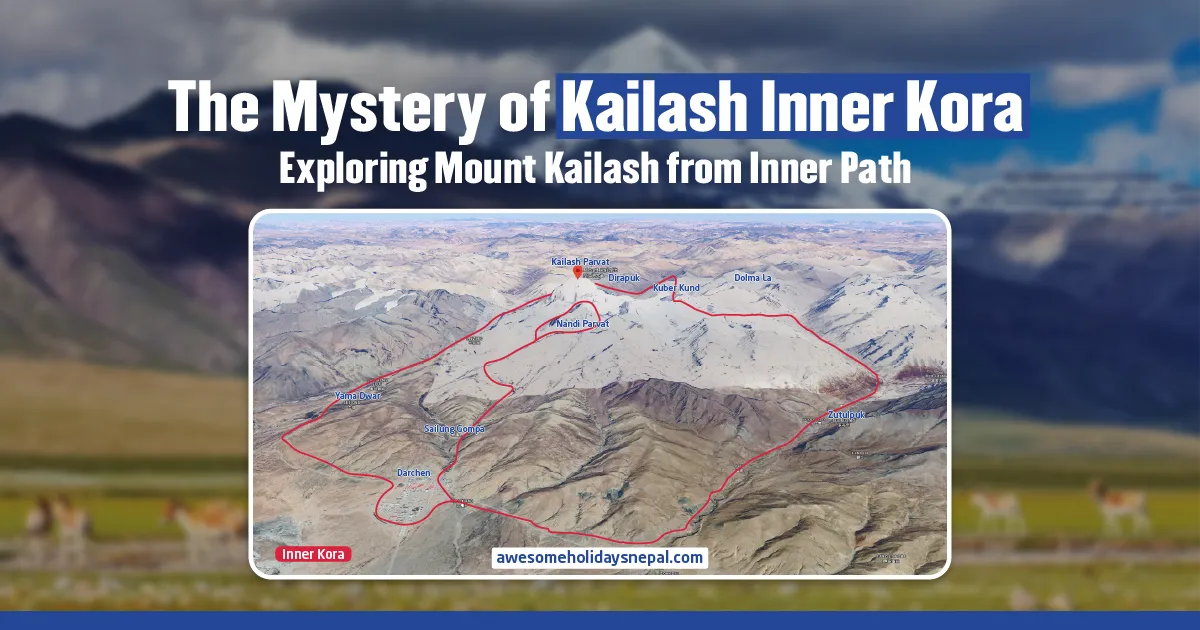
The Kailash Inner Kora, or the Inner Parikrama, is a shorter trek that takes you very close to Mount Kailash. It is a more spiritual circuit around a smaller mountain, to the southwest of Kailash. The trek to this smaller peak, known as Nani Parva, is significantly more challenging and demanding than the outer Kora.
It takes two days to complete the inner Kora, giving a chance to observe various valleys and passes, including Atmalingam and Asthapath. The Kailash Kora takes you on a journey into the heart of Kailash, offering an opportunity to observe various valleys and passes, including Atmalingam and Asthapath.
How to do the Kailash Inner Kora?
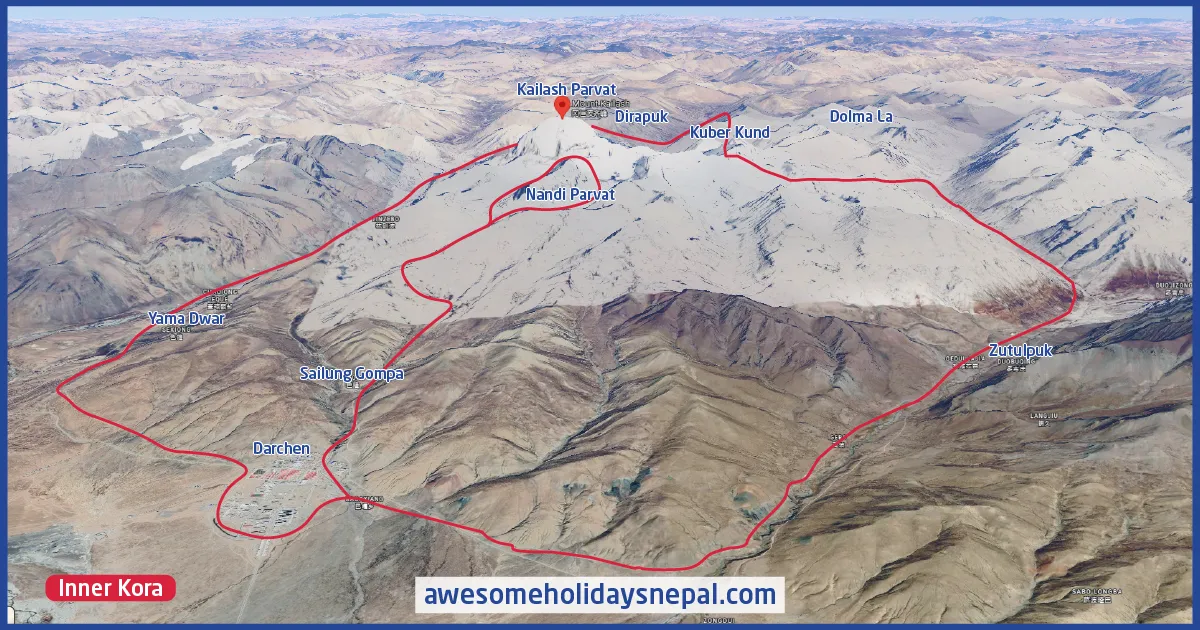
Darchen is where you start your journey to the Kailash Inner Kora. Darchen is a small town in the south of Mount Kailash. Darchen is the place where you stay before commencing your out and inner kora. Most people, after completing the outer kora for three days, rest here and start their walk to the inner kora the next day.
On the way, the Serlung monastery is the first monastery you see. Passing through the Serlung Monastery, you take a left towards Nandi Parvat. After crossing the high Nandi La Pass, one of the hardest points in the inner kora, see the Atmalingam and Saptarishi Caves before returning to Darchen.
Darchen (4,675m) → Selung Monastery (5,020m) → Foot of Kailash (5,600m) → Saptarishi Cave (5,860m) and 13 Golden Chortens → Nandi La Pass (5,805m) → Selung Monastery → Gyangdrak Monastery (5,060m) → Darchen
The Mount Kailash Inner Kora Trek is a span of around 34 km. But the real journey is not measured in kilometers but in faith.
What to observe during the Kailash Inner Kora?
- Nandi Parvat
- Asthapad
- Saptarishi Caves
- Kuber Kunda
- Charan Sparsh
- Khandro Sanglam La
- Serlung Gompa
- Selung monastery
- Gyangzha Monastery
Nandi Parvat: The Silent Vehicle
Nandi is the vehicle of lord shiva. Nandi is the sacred bull or Lord Shiva. There lies a hill in front of Mount Kailash that looks like a sitting bull. This parvat stands still before Mount Kailash like a sentinel, showing eternal devotion to lord Shiva. This hill, frozen in rock, is believed to be the messenger of lord shiva. If you have any message for lord shiva, always whisper in Nandi’s ears, and he will convey your message to Lord Shiva.
Asthapad: The Eight Steps to Nirvana
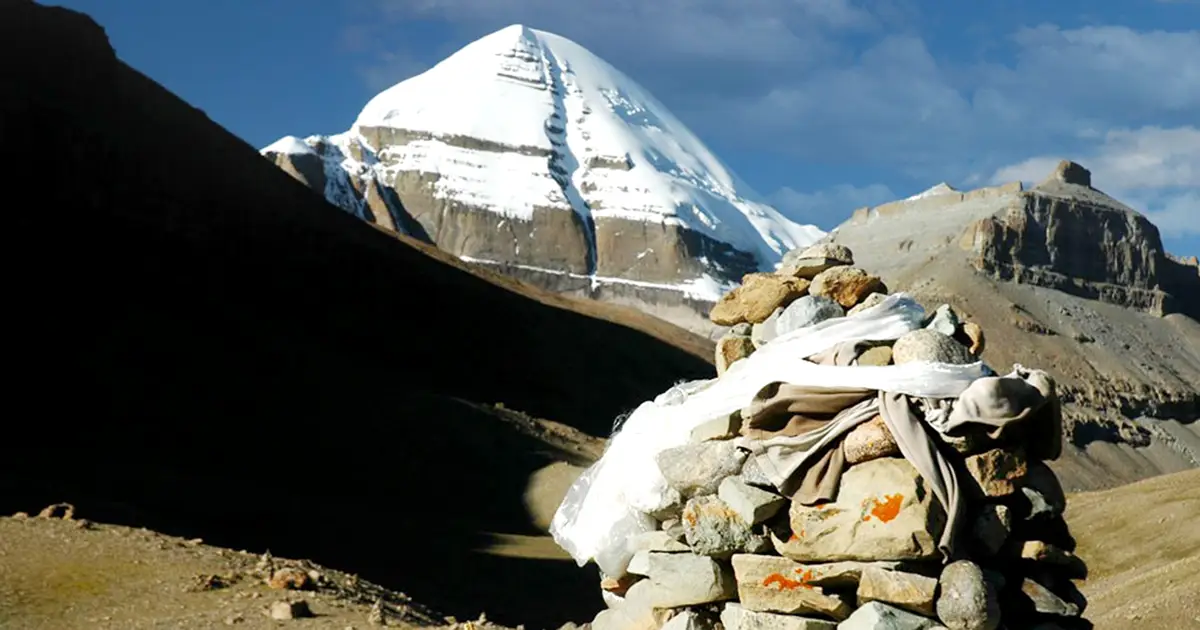
On the way to Kailash inner kora, there is the Astapad, meaning eight steps to liberation. It is the place where Rishavdev, the first tirthankar, got nirvana. It is the place where Jainism was first born. The first tirthankar is also known by various names. He is also called Aadinath, meaning the first lord. Adishvara, Yugadideva, Prathamaraja, and Nabheyaa are his other names Jains use to call him. Asthapad is one of the few places mostly visited by Jain people. It is also the spot from where you get the closest view of the west Face of Kailash.
Saptarishi Caves: The cave of Seven Sages
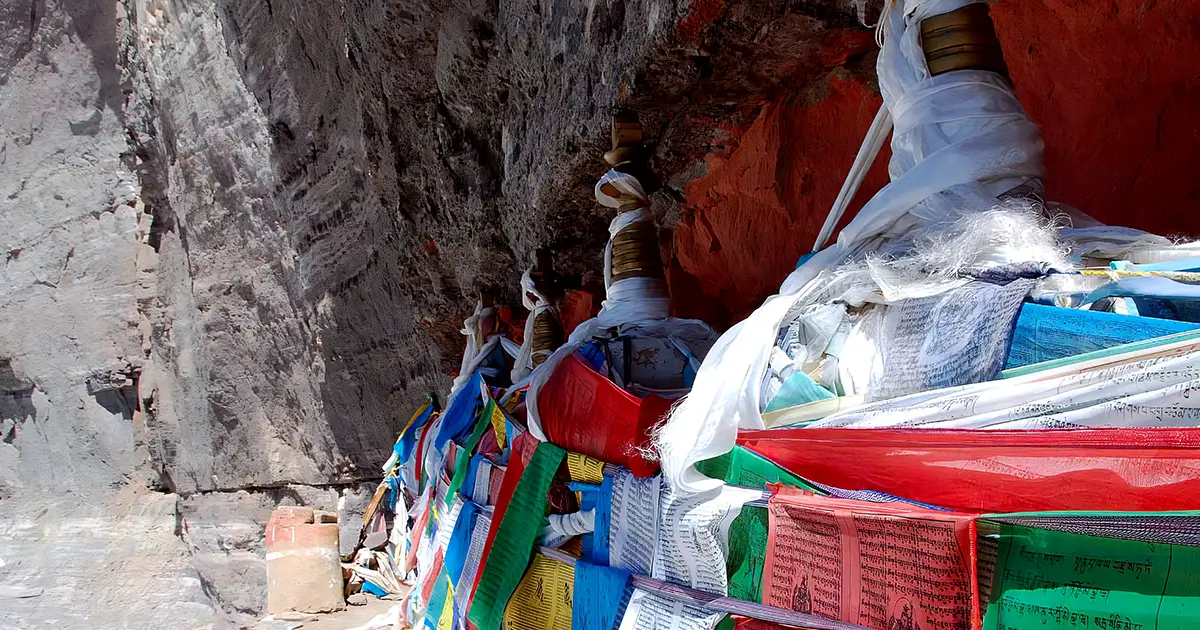
Hidden inside the cliffs, there are these natural caves, believed to be where the great seven sages meditated. These Seven Great Sages, namely Atri, Jamadagni, Bharadvaja, Kashyapa, Vasistha, Gautama, and Vishwamitra, are still meditating for eternal peace. The panorama from the Thirteen Sacred Golden Stupas (Chortens) at the Saptarishi Cave, at the foot of the South Face of Mount Kailash, is built to honour the relics of seventeen high lamas from the Drigung Kagyu lineage. Climbing to these caves is not as easy as it sounds. You need to climb with the help of ropes hanging from the cliff. Courage, skill, and mental stability are required to climb the cliff and the cave.
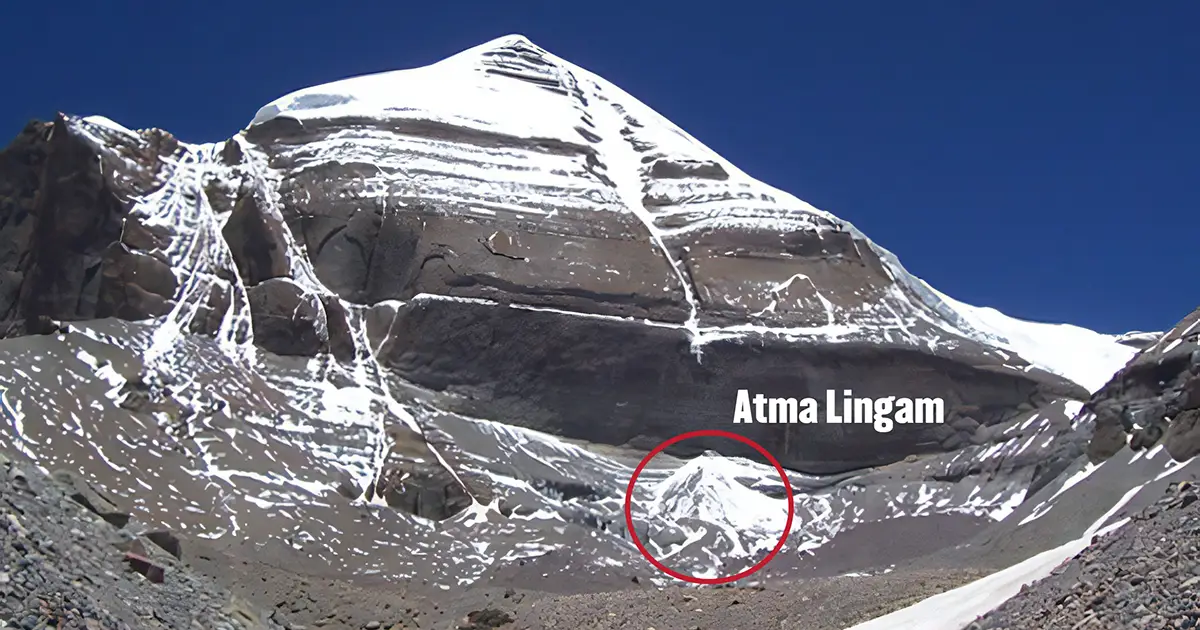
Atmalingam: The Iced Spirit of Kailsh
A linga (or lingam) is an aniconic representation of Lord Shiva. The atma lingam in Kilash is a conical structure formed by the accumulation of ice and snow falling from the western face of Mount Kailash. Atmalingam is the core representation of the cosmic power of Mount Kailash. There are two smaller lakes, called White Lake and Red Lake are found nearby, symbolising opposite energies of purity and power, creation and destruction. The holy water flowing from Atmalingam is the origin of the sacred Sailodha River.
Kuber Kund and Kuber Parvat
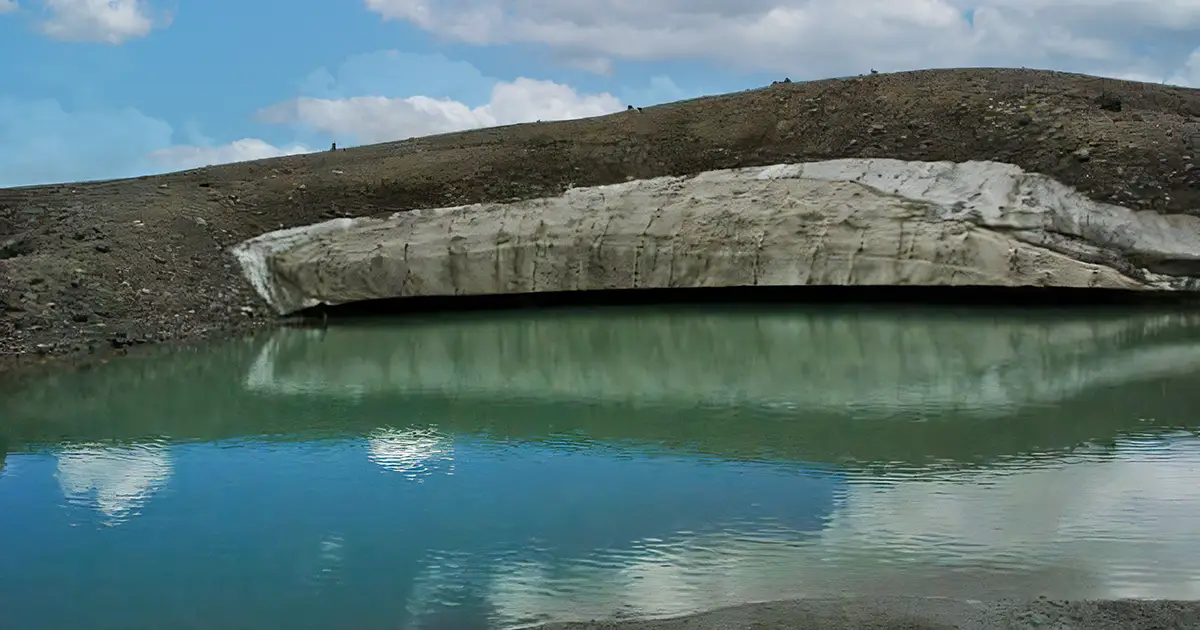
Kuber, also known as Zambhala in the Tibetan dialect, is the guardian of wealth and prosperity. Named after the Lord of Wealth, Kuber Kund sits in front of the eastern face of Kailash. Symbolically, one who prays to him will receive the wealth of spirituality and selfness and be taught to detach from materialistic properties. On clear weather, the reflection of Mount Kailash is clearly seen in the silent water of Kubetr alke, which will purify your karma of seven lifetimes.
Khandosalgam La Pass
The Khandosalgam La Pass (also spelled Khandro Sanglam La) is a high pass connecting Mount Kailash and Mount Nandi. It is one of the challenging passes to be crossed during the Inner Kailash Kora. The pass lies to the north of Mount Kailash.
Khandro Sanglam La is a Tibetan word, meaning Secret Path of the Dakini. Dakinis are the female wrathful spirits in Bon and Buddhism. Trek to Khandro Sanglam La is even difficult and technical than crossing Dolma La, one can be done only with the help of a local Tibetan Guide. Due to this reason, this Kailash Inner Kora is considered a spiritual journey.
The Technical Challenge and Sacred Permission
It is believed that only those who have completed the Kailash Inner Kora 12 times are eligible to do the inner kora. This also somehow connects to the fact of difficulty and the hardness required to complete the inner kora. You need to be spiritually and physically prepared for this inner kora. This is why the Inner Kora is not open to everyone. Tibetan guides are often heard saying, “You do not choose to do the Inner Kora. Kailash decides if you are ready.”
The major technical sections in the Kailash Inner Kora include:
- Climb to the Saptarishi Cave, on the cliff
- Crossing the Nandi La Pass (5,805m)
You might need additional ropes, crampons, a carabiner, and a trained guide to climb the steep Saptarishi caves. Also, be aware of the cold and wind, which will test your endurance. Also, there is a risk of Kailash Inner Kora altitude sickness. Read the blog on How to Prevent High-Altitude Sickness in Mount Kailash Kora.
Best Time for Kailash Inner Kora
May to mid-June and September to mid-October are the best times for the inner kora of Kailash. The weather is relatively stable with low snow, clearing your path in the high passes. Since only a limited number of permits are issued by the Tibet Tourism Bureau, book your journey now with Awesomne Holidays Nepal.
Planning Kailash Mansarovar Yatra in 2026?
Essence of Inner Kailash Kora
As you complete the Inner Kora and return to Darchen, exhaustion gives way to emptiness, you feel lighter, and you have an awesome feeling of achievement. Your call for Inner Kora Kailash has been accepted. You leave a part of you in the inner kora, a footstep to a spiritual journey of you.
Mount Kailash does not call you for climbing; it calls for devotion and surrender. Every site you visit in the inner Kailash kora is not a destination but a cosmic hub for spiritual transformation. Every step you are closer to Kailash, each site vibrates with the chant of Om Namaha Shivaya and Om Mane Padme Hum. Every rock speaks the tales of the pilgrims and monks who achieved nirvana here.
Visit Kailash to rejuvenate your inner energy!
FAQs
Expand AllWhat is Kailash Inner Kora?
The Kailash Inner Kora is the most sacred and challenging circuit encircling the Nandi Parvat. The outer kora is completed in three days, whereas the inner kora lasts for two days.
The outlier kora takes you to the outer boundaries of Mount Kailash, and the Inner Kora takes you closer to the mountain, providing opportunities to witness Nandi Parvat, Atmalingam, Asthapath, and Saptarishi Caves.
How difficult is the Kailash Inner Kora?
The degree of Kailash Inner Kora difficulty is extremely high. The Kailash Inner Kora goes above 6,000 meters, crosses high passes, rocky cliffs, and glaciers. Only experienced trekkers are allowed to go for the inner Kailash trek with a local Tibetan guide.
Can anyone do the Kailash Inner Kora?
No, the Kailash Inner Kora is not meant for everyone. Interested candidates must be experienced trekkers and need a special permission form Tibet Tourism Bureau. The Kailash Inner Kora permit 2025 was given only to a few monks, selected groups, and those who have completed the outer Kora multiple times.
What is the best month for Kailash Inner Kora?
May to September is the best season with clear weather, open sky, and moderate temperatures. April and October are also preferred with snowfall.
Do you need a guide for the Kailash Inner Kora?
Absolutely yes. A Kailash Inner Kora guide must be with you to complete the Kailash Inner Kora. The trekking trail is hidden, unmarked, and often covered with snow. The experienced guide knows the trail and can help you stay safe during the inner kora.
How many days does Kailash Inner Kora take?
On a normal day, if everything goes fine, the inner kora is completed in two days. Make sure to acclimatize near Diraphuk and Asthapath.
What permits are needed for Kailash Inner Kora?
Tibet Travel Permit, a Kailash Inner Kora permit, and a group visa from the Chinese government are required for the Inner Kailash Kora.
Is Kailash Inner Kora dangerous?
Kailash Inner Kora is risky. The Kailash Inner Kora goes above 6,000 to cold winds and slippery slopes. If not planned and prepared well, you might get altitude sickness. Staying hydrated and taking slow steps will keep you safer.
What is the altitude of Kailash Inner Kora?
The highest point on the Mount Kailash Inner Kora trek goes as high as 6,000 meters (19,685 feet).
Can beginners do the Kailash Inner Kora?
No, beginners should not try for Kailash Inner Kora. You should complete the Outer Kora multiple times to know the trails better and acclimate to breathing at high altitude.
What should I pack for Kailash Inner Kora?
Trekking to the freezing high passes above 6,000m needs planned packing. You need warmer thermal layers, a down jacket, good trekking boots, gloves, lights, dry fruits, and water. You will thank me later for remainding of trekking poles.
Are there medical facilities on Kailash Inner Kora?
Not really. Once you start, there are no hospitals or clinics on the Inner Kora. You must carry your own medical kit and oxygen cylinder if possible.
Is photography allowed on Kailash Inner Kora?
Photography is allowed in most parts of the inner kora. But ask your guide to take photos and videos in some caves and religious structures.
Can I do Kailash Inner Kora without a group?
No, trekking to the Kailash kora is not possible for an individual. You must apply for the visa and permits in a group. The outer kora can be done with a smaller group, but for the inner kora, you need a special permit, trained guides, and a team for your safety.
Are there age restrictions for Kailash Inner Kora?
Inner Kora in Kailash is only allowed to the pilgrims between 18 and 65 years. The journey is very challenging and full of risks as well as spiritual awakening.
What food is available during the Kailash Inner Kora?
The food during the Kailash Inner Kora is mostly vegetarian. Meals like instant noodles, soups, Tibetan tea, and dry snacks are available, but meat or alcohol is not permitted there.
Related blog posts
Discover a choice of tourist destinations loved by most of our visitors. Whether you're on a jungle safari to spot rare animals or walking through a world heritage site, these well-planned itineraries cover the major highlights of Nepal.
 call an expert at: