
Everest is the tallest mountain, and every year thousands of people make their dream come true by standing on the peak of summit. So, dare yourself to the Everest Expedition adventure.
Mauna Kea vs Mount Everest: Who’s Really Taller in 2025?
 Sristi Adhikari
Have you ever found yourself deep in thought about which is the tallest mountain in the world? Mauna Kea vs Mount Everest. Well, most people say even without hesitation that Everest is the tallest mountain in the world. Which is so true.
The comparison between Mauna Kea and Mount Everest has become an emerging topic of discussion among parties or gatherings. The concept of the tallest mountain means a peak rising above the world, not one whose half of its height is submerged in the deep ocean.
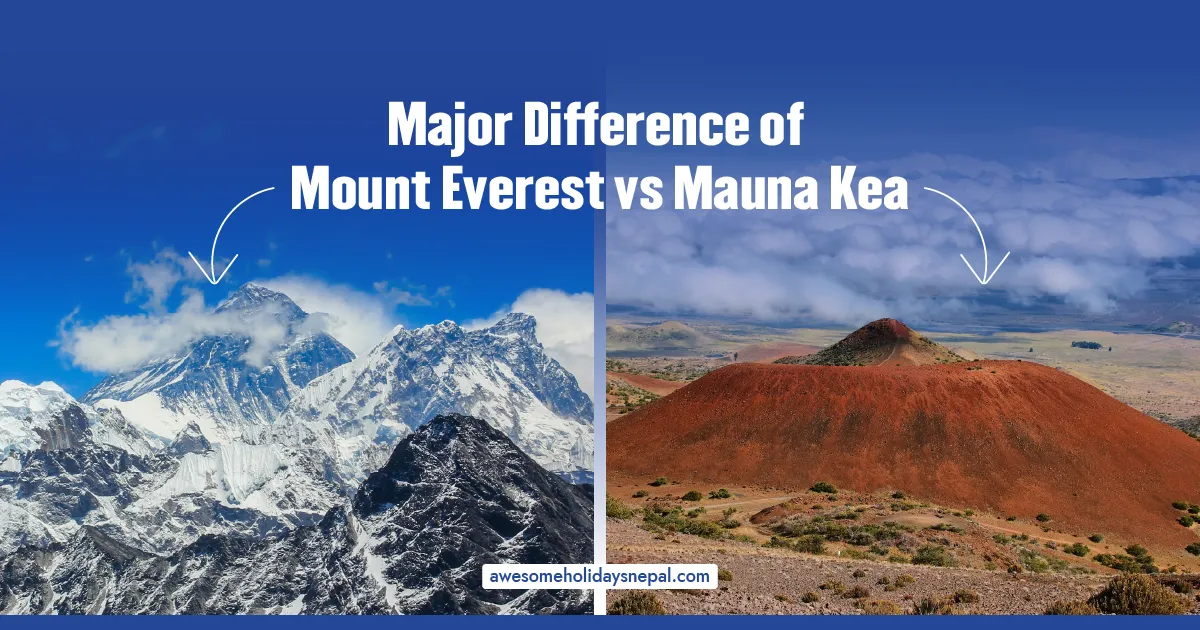
Everest is visible in all its glory at an elevation of 8,848.86 meters and is the tallest mountain from sea level. If we look at Mauna Kea’s height from sea level, it’s only 4,207 meters above sea level. Even though from the base of the ocean, Mauna Kea’s 10,210 meters, and its height of 6,003 meters, are submerged inside the deep ocean.
Let’s dive deeper into the comparison between Mauna Kea vs Mount Everest:
Inside the Mauna Kea vs Mount Everest Comparison
Location and Height
Mount Everest is located in the Mahalangur Himal sub-range of the Himalayas along the Nepal-China border. It is surrounded by the highest mountains, like Nuptse, Makalu, Cho Oyu, Pumori, and so on. Everest is the highest peak above sea level, with a dramatic mountain geography. The Everest region is remote, rugged, and high altitude plateau base.

On the other hand, Mauna Kea is a dormant volcano located on the Big Island of Hawaii, USA. It stands at a height of 4,207 meters above sea level, but its height from the base of the ocean is 10,210 meters. Mauna Kea’s geography is full of lower forest, alpine areas with different unique species, and the lands are covered by red cinder cones resulting from eruptions.
Geological Features
Everest is roughly 60 million years old. It was formed by the tectonic collision between the Indian and Eurasian plates. The collision resulted in the rise of layered rocks with a composition of metamorphic schists and gneisses, along with sedimentary remains of an ancient seabed at the top of the mountain peak. Everest is consistently growing every year.
In contrast, Mauna Kea is around a million years old. It is a dormant volcano formed by a volcanic eruption when magma beneath the Pacific Plate repeatedly broke through the ocean floor.
Physical Characteristics
Mount Everest has rugged terrain with icy slopes, whereas Mauna Kea has broad, gentle slopes made up of an unlimited flow of Lava. Everest is a steep mountain and has a slope of 35°, which makes the trek and expedition very challenging, but Mauna Kea’s wide, dome-like, and gradual inclination makes the drive and hike comfortable.
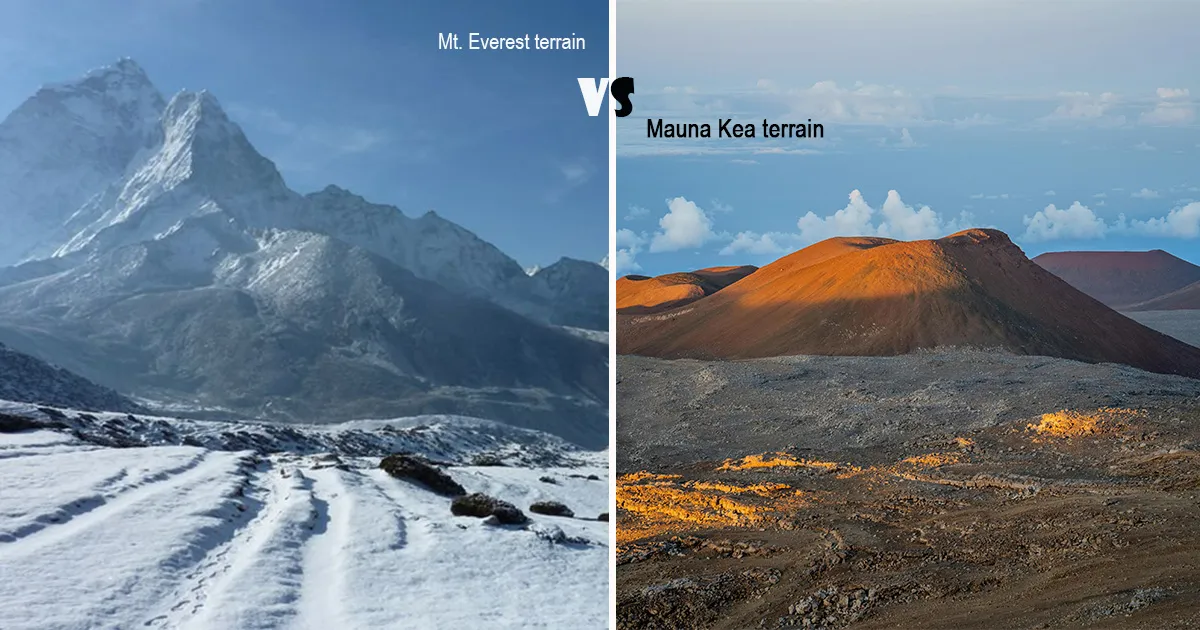
The icy and windy landscape with sharp edges and the most dangerous Khumbu glaciers make the navigation and expedition to the Everest summit more technically challenging.
Expedition Difficulty and Accessibility
The Mount Everest expedition is technically challenging, which makes it the toughest climb in the world. An expedition to the top of Mount Everest requires weeks of acclimatization, technical climbing skills, and a well-organized expedition team, and you need to overcome challenges like the Khumbu Glacier, thin air, freezing temperatures, and unpredictable weather.
The high risk of altitude sickness, high altitude, crevasses, and threats of avalanches on the way could even take a life. Likewise, the Mauna Kea ascent is very accessible, and one can reach the top via driving and 6 to 8 hours of hiking. The road is quite steep, but four-wheel vehicles can easily take you to the summit.
Cultural and Spiritual Significance
Both mountains hold deep spiritual and cultural significance to their natives. Everest symbolises strength, purity, and the connection between heaven and earth, and is known as the Mother Goddess of the World. Tibetans call it Chomolungma, while it’s called Sagarmatha in the Nepali language. You need to perform a puja ceremony for climbing as per the new rules.
Mauna Kea is also a sacred mountain for Hawaiian natives, and it symbolises ancestral power, gods, and celestial forces. It is also known as white mountain and is a place where earth meets sky. There are different Hawaiian religious sites, altar platforms, and burial caves where locals perform their rituals and offerings.
Scientific Importance
Everest is a high-altitude mountain that serves as a natural laboratory. Different kinds of studies related to climate, geology, and human physiology can be performed by scientists and researchers. You can also analyse global warming by studying Sagarmatha’s glaciers. The fossil of marine in the peak of Everest shows that this highest peak in the world was once beneath the ocean.
Similarly, Mauna Kea also holds scientific importance related to astronomy and geology. The clear skies above this mountain are an ideal location for studying distant galaxies, exoplanets, and cosmic phenomena. A geologist can study the ocean islands and how long the evolution of Earth’s crust has been.
Tourism
Everest is popular for peak climbing and other thrilling trekking to the EBC. Other expeditions like Lobuche Peak Climbing, Island Peak Climbing have also attracted the hearts of adventure enthusiasts all around the world. The Everest region is popular for its unique lifestyles, centuries-old cultures, monasteries, and celebrations, and belongs to the Sherpa people and Tibetan culture. Every year, thousands of trekkers and expeditions enter the Everest region.
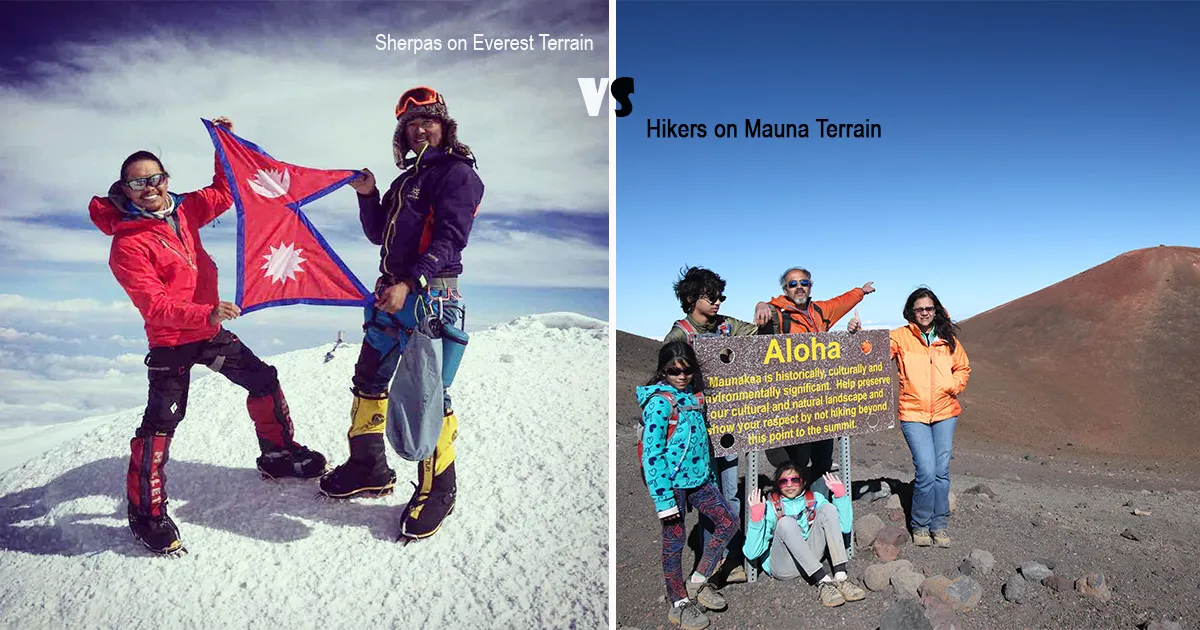
Mauna Kea is popular among stargazers and nature enthusiasts. The breathtaking views of sunset and sunrise are perfect for photography enthusiasts. Similarly, it is also best for hiking, doing cultural tours, and observing constellations and galaxies.
Best Season
The ideal season for the Everest expedition is spring (April to May) and autumn (late September to November). The stable weather, clear skies, and hard ice due to extreme cold make it the best season for the Everest expedition and nearby trekking.
Likewise, one can visit Mauna Kea all year round. April and October months mild weather makes the best months to visit due to mild weather. One can explore the Mauna Kea in winter as it offers a rare sight of tropical Hawaii, where palm trees are covered with snow. The flexible access and year-round beauty don’t demand a particular season.
Mauna Kea vs Mount Everest
The difference between Mauna Kea and Mount Everest, in contrast to different factors like location, elevation, type, and age, is given below:
| Factor | Mauna Kea | Mount Everest |
| Location | Hawaii, USA | Nepal–China border of the Himalayas |
| Elevation Above Sea Level | 4,207 m (13,803 feet) | 8,848.86 m (29,031.7 feet) |
| Height From Base to Summit | 10,210 m (33,500 feet) from the ocean floor | 8,848.86 m (29,031.7 feet) |
| Type | Dormant volcano | The folded mountain is part of the Himalayan range |
| Base Location | Sea Floor of the Pacific Ocean | Tibetan Plateau |
| Age | About 1 million years | About 60 million years |
| Notable Feature | The tallest mountain in the world, when measured from the base | Tallest mountain above sea level |
| Accessibility | Road access near the summit (requires permits) | Requires a high-altitude mountaineering expedition |
| Climate at Summit | Cold, dry, excellent for astronomy | Extreme cold, low oxygen, harsh weather |
Mauna Kea Vs Mount Everest, Who is The Champion?
When debating about Mount Everest vs Mauna Kea, Everest always wins. The concept of the tallest mountain always refers to Mount Everest, as it stands tall in the Himalayas with an elevation of 8,848.86 meters above sea level. Mauna Kea’s height above sea level is only 4,207 meters, so it doesn’t stand near Mount Everest.
The mountain, which stands tall above sea level, is Mount Everest, whereas Mauna Kea, with most of its height, is submerged in the deep ocean; it can only be called tall if we measure underwater. Mauna Kea can be called a giant in total height of more than 10,000 meters from the base of the Pacific Ocean, but the position of the tallest mountain in the world only belongs to Mount Everest.
FAQs
Expand AllIs Mauna Kea actually taller than Mount Everest?
No, Mauna Kea is not taller than Mount Everest. If we compare Mauna Kea from its base on the ocean floor, its height will reach over 10,000 meters, while Everest is only 8849 meters.
Why is Mauna Kea considered the tallest mountain in the world?
Mauna Kea is only taller if we measure its height from the base of the ocean floor. If we measure from the sea level, not from the base it is only 4,207 meters.
How tall is Mauna Kea from its base on the ocean floor?
Mauna Kea stands at a height of 33,500 feet (10,210 meters) from its base on the Pacific Ocean floor to its peak.
What is the real height of Mauna Kea?
Mauna Kea’s height depends on the method of measurement. If we measure from the base of the ocean, it is 33,500 feet (10,210 meters), but it is only 13,796 feet (4,207 meters) above sea level.
Is Everest or Mauna Kea taller?
Everest is taller than Mauna Kea.
How much of Mauna Kea is underwater?
Mauna Kea is 60% underwater, which is 19,700 feet (6,000 meters).
Why do people say Everest is the highest but Mauna Kea is the tallest?
Everest is the highest peak above sea level, but Mauna Kea is only the tallest if we measure it from the base of the ocean. That’s why Everest is the highest peak.
What is the difference between highest and tallest mountain?
The difference between the highest and tallest mountain is that Everest is high in elevation when measured from sea level, while Mauna Kea is the tallest only if we measure from the base of the sea.
How tall is Mount Everest above sea level vs Mauna Kea?
Mount Everest is 8,848.86 meters above sea level while Mauna Kea is only 4,207 meters.
Can you compare Mauna Kea and Mount Everest?
Yes, you can compare Mauna Kea and Mount Everest. Everest is 8,848.86 meters above sea level while Mauna Kea is only 4,207 meters.
Which mountain is technically taller: Everest or Mauna Kea?
Mauna Kea is technically taller than Everest.
How tall would Mauna Kea be if it wasn’t underwater?
If Mauna Kea weren’t underwater, it would be over 33,500 feet tall.
Is Mauna Kea the tallest mountain on Earth from base to peak?
Only if we measure its height below the sea level, Mauna Kea would be the tallest mountain on Earth.
Does Mauna Kea beat Everest in height?
No, Mauna Kea doesn’t beat Everest in height. Everest is 8,848.86 meters above sea levelwhile Mauna Kea though only 4,207 meters.
What is the total height of Mauna Kea including underwater?
The total height of Mauna Kea, including underwater, is 10,210 meters (33,500 feet).
Why isn’t Mauna Kea recognized as the tallest mountain?
Mauna Kea is recognized as the tallest mountain because it is only 4,207 meters (13,800 feet) above sea level.
How does Mauna Kea measure over 10,000 meters?
The Mauna Kea measures over 10,000 meters only if measured from the base of the ocean.
Mount Everest vs Mauna Kea: which one is bigger?
Mount Everest is bigger than Mauna Kea.
Is Mauna Kea taller than Everest from the bottom of the ocean?
Yes, Mauna Kea is only taller than Everest from the bottom of the ocean.
What’s the base-to-summit height of Mauna Kea vs Everest?
Mauna Kea is over 10,200 meters, while Everest is 3,600 meters when measured from base to summit.
Related blog posts
Discover a choice of tourist destinations loved by most of our visitors. Whether you're on a jungle safari to spot rare animals or walking through a world heritage site, these well-planned itineraries cover the major highlights of Nepal.



 call an expert at: