
Lobuche East vs Island Peak: Which Himalayan Peak Suits You Best?
 Sujata Pokhrel
Nepal has multiple peak-climbing destinations spread across different Himalayan regions. Often enjoyed as an additional, extended trip on the Everest Base Camp trek, the peaks in the Khumbu region are quite popular for peak climbing.
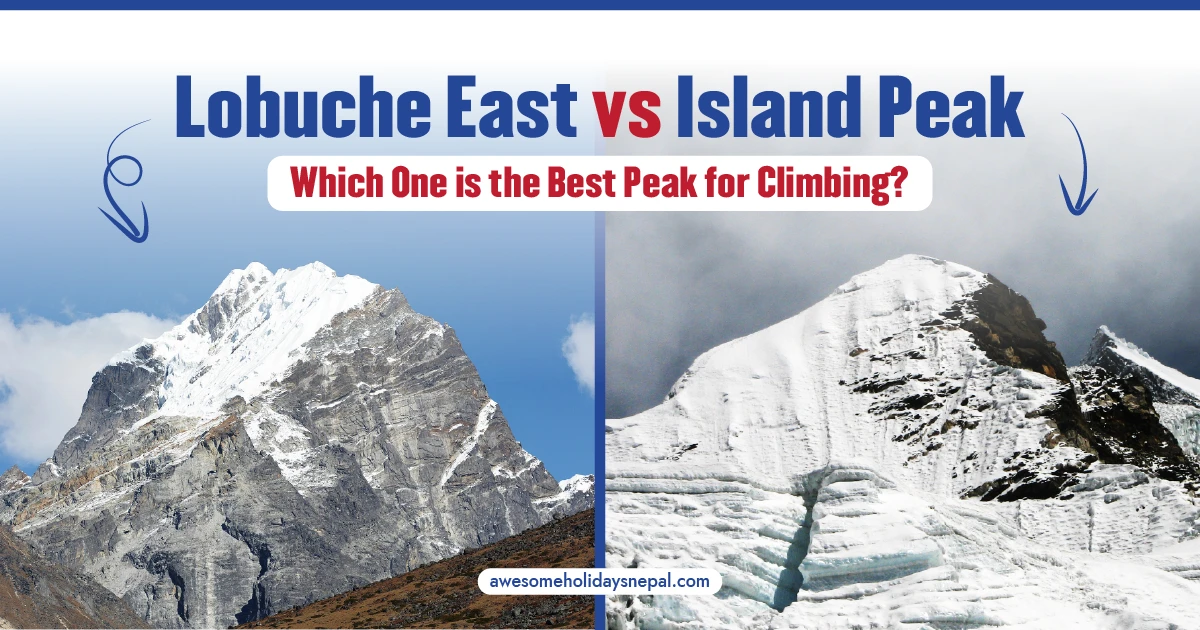
Among the many peaks of Khumbu, Lobuche East vs Island Peak is a debate: which is the best? Well, that’s a pretty tough question to answer! Honestly speaking, which peak suits best is a very tough question to answer, as it depends on one’s caliber, fitness, and, obviously, the season’s favorability.
For many travelers, peak climbing in Khumbu is a natural extension of the famous Everest Base Camp trek. After trekking through Sherpa villages, ancient monasteries, and glacier valleys, climbers often add a summit attempt to make the journey even more memorable. Two peaks in particular stand out for this purpose: Lobuche East and Island Peak.
Factors such as physical fitness, prior mountaineering experience, technical skill, and even seasonal conditions all play a role in determining which summit will be the right choice. While both peaks rise above 6,000 meters and lie within the Everest region, the experience they offer can differ significantly.
Understanding those differences is key to choosing the climb that suits your goals and abilities.
Overview of Lobuche East and Island Peak
Lobuche East and Island Peak are two of Nepal’s most popular trekking peaks, both located in the Khumbu region within Sagarmatha National Park. These peaks attract climbers from around the world who wish to experience Himalayan mountaineering without committing to extremely technical expeditions.
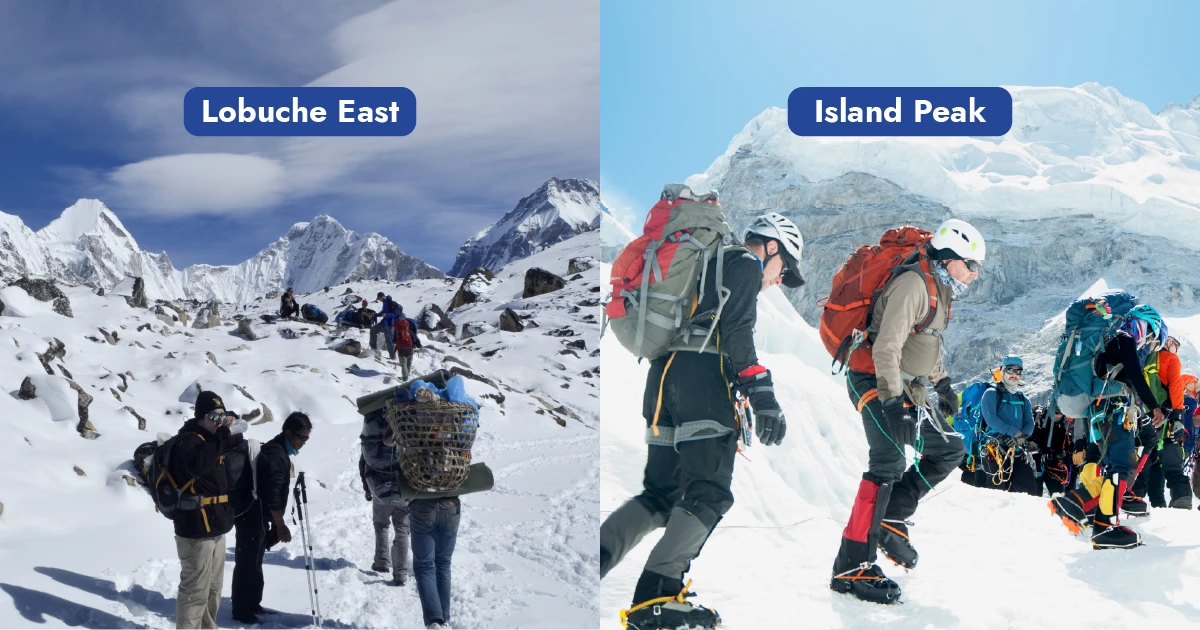
Island Peak, also known as Imja Tse, stands at 6,189 meters and sits in the Imja Valley near the village of Chhukung. The mountain gained its name because it appears like an island rising from a sea of glaciers when viewed from Dingboche. It has long been considered a classic training peak for climbers aspiring to tackle larger Himalayan mountains.
Lobuche East, at 6,119 meters, lies close to Lobuche village along the Everest Base Camp route. Though slightly lower in elevation, it is often regarded as a more technically demanding climb due to its exposed summit ridge and mixed terrain.
Both peaks offer spectacular views of iconic Himalayan giants, including Everest, Lhotse, Nuptse, and Ama Dablam. Yet despite their proximity, the nature of the climb differs enough to make each peak appealing to different types of climbers.
Key Differences Between Lobuche East vs Island Peak
Although both mountains fall under Nepal’s category of trekking peaks, several factors distinguish them from each other. These differences range from altitude and terrain to climbing difficulty and popularity.
Understanding these aspects can help climbers determine which peak aligns better with their skills, expectations, and adventure goals.
Elevation
Island Peak is slightly taller than Lobuche East.
- Island Peak: 6,189 meters
- Lobuche East: 6,119 meters
While the difference of 70 meters may seem minor, altitude plays an important role in high-mountain climbing. Higher altitude means thinner air and potentially greater challenges related to acclimatization.
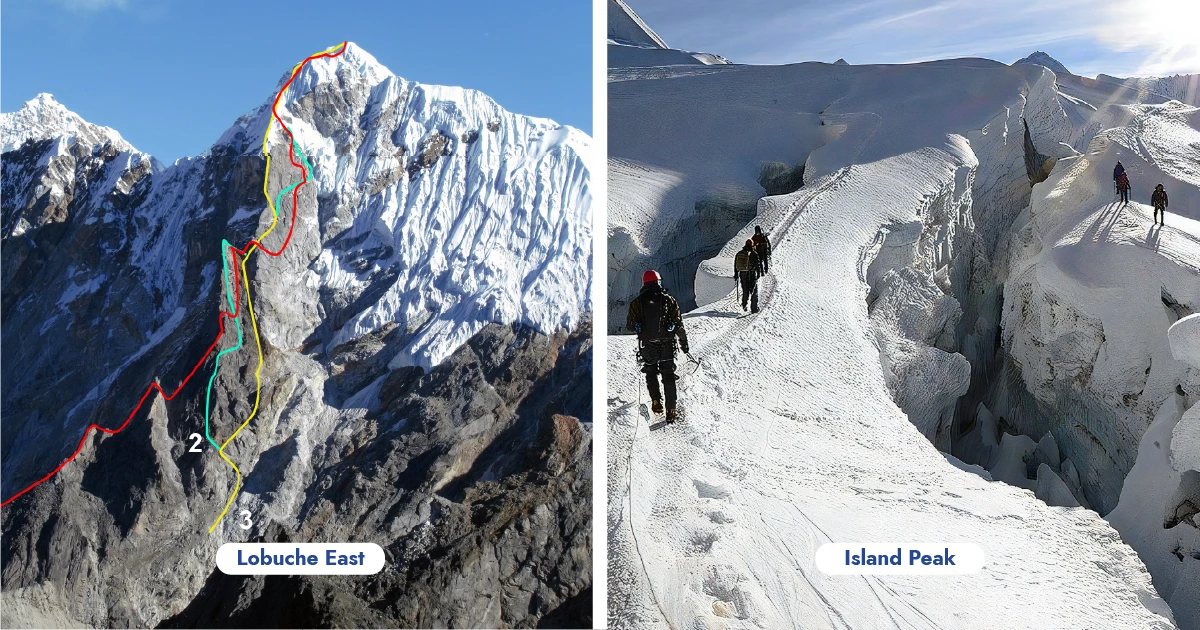
However, elevation alone does not determine difficulty. In fact, despite being slightly lower, Lobuche East is often considered more technically demanding than Island Peak
Climbing Route and Terrain
The terrain encountered during the climb is one of the biggest distinctions between the two peaks.
Island Peak
The route to Island Peak involves glacier travel across the Imja Glacier. Climbers navigate crevasses and may cross ladders placed over deep gaps in the ice. The final section involves ascending a steep ice headwall using fixed ropes before reaching a narrow summit ridge.
Island peak’s terrains mainly consist of snow slopes, glacial sections, ice walls and crevassed glacier fields. Although technical equipment is required, the route is relatively straightforward with proper guidance.
Lobuche East
The climb on Lobuche East is more varied and often more exposed. After ascending rocky slopes to high camp, climbers reach a snow ridge that leads toward the summit. The summit ridge itself can be narrow and requires careful footwork.
It’s terrain typically consists of rocky ridges, snowy and ice slopes with mixed rock and ice-climbing. And the summit ridge is fully exposes unlike the other peak.
Trekking Route and Scenery
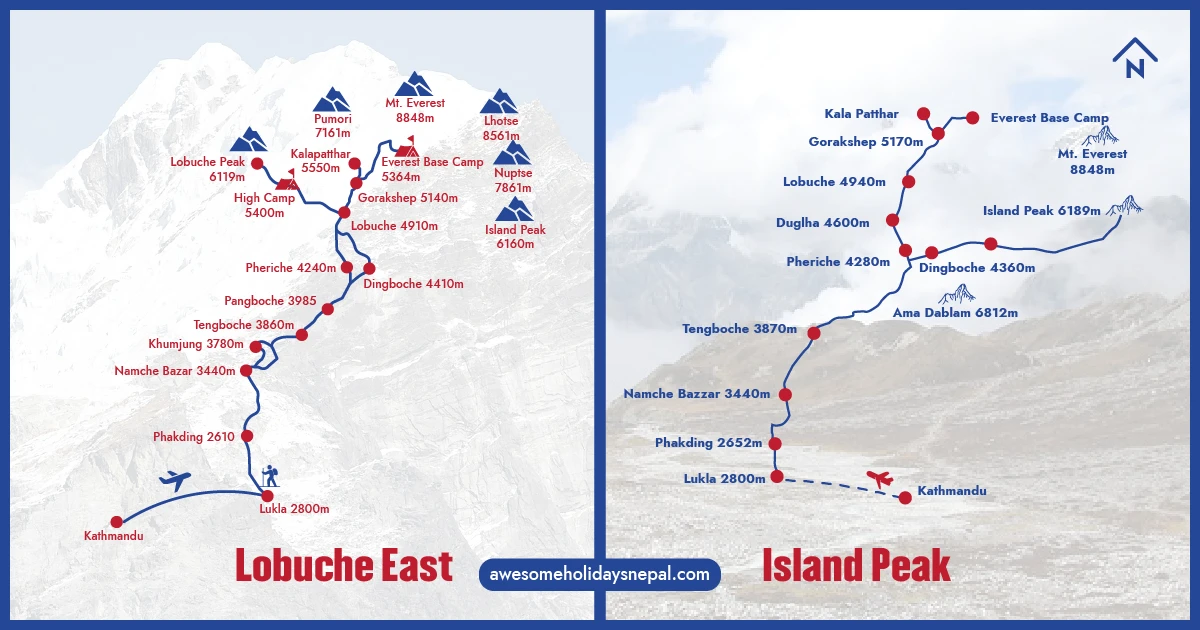
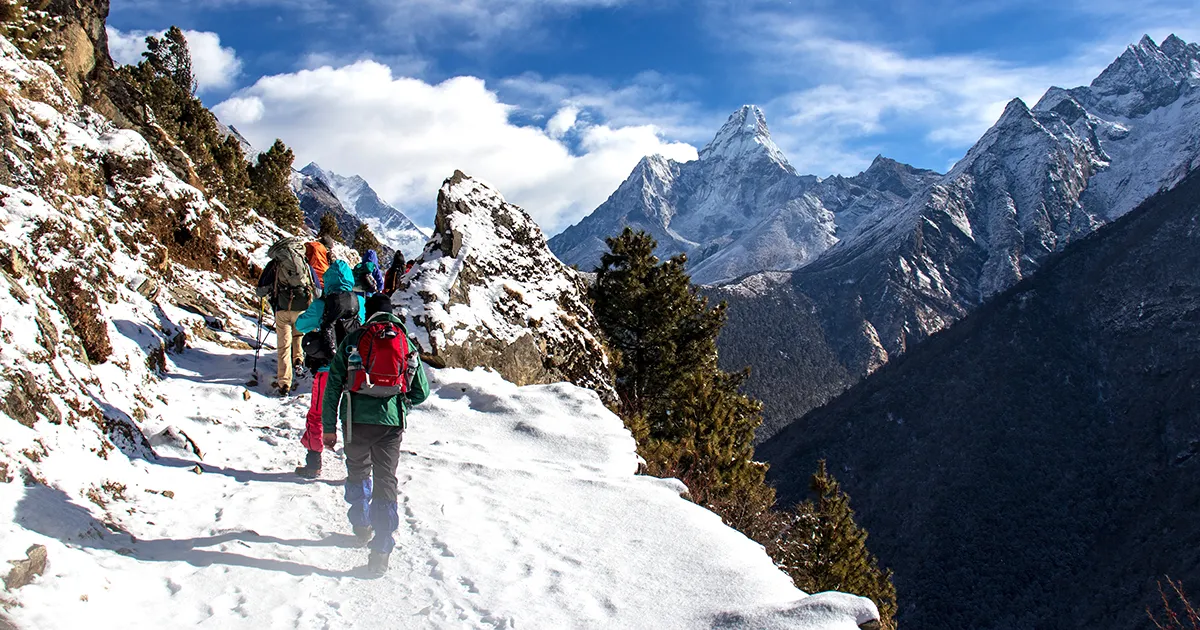
Both expeditions follow much of the famous Everest Base Camp trekking route, allowing climbers to enjoy some of the most beautiful landscapes in the Himalayas. Trekkers will have to pass through some of the iconic locations of Everest region like Lukla, Namche Bazaar, Tengboche monastery, and Dingboche.
However, the routes diverge slightly toward the end. Island Peak climbers typically head toward the Imja Valley via Chhukung, a small settlement surrounded by dramatic peaks. Whereas, the Lobuche East climbers continue along the Everest Base Camp trail toward Lobuche village before approaching the mountain.
In terms of scenery, both routes offer extraordinary views of Everest, Lhotse, Ama Dablam, Nuptse, and other towering peaks of the Khumbu region. Many climbers combine the trek with a visit to Everest Base Camp and Kala Patthar to maximize the Himalayan experience.
Technical Difficulty
Technical difficulty is where the difference between Lobuche East and Island Peak becomes more noticeable.
Island Peak is widely considered the more beginner-friendly option. While it requires the use of crampons, harnesses, ropes, and ice axes, the route is typically well established and guided climbs provide support with fixed ropes and safety systems.
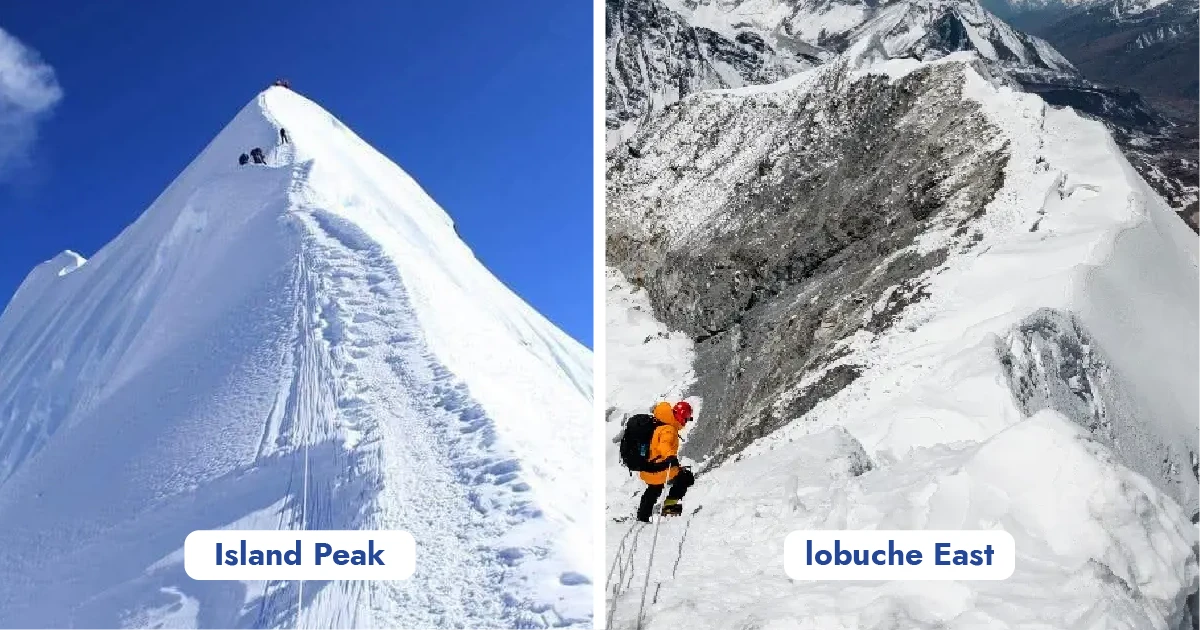
Lobuche East, however, demands stronger mountaineering ability. The exposed summit ridge, steeper sections, and mixed terrain require greater confidence with technical equipment and movement on rock and ice.
For this reason, Island Peak is often recommended for first-time Himalayan climbers. Lobuche East is better suited for climbers with some prior mountaineering experience.
Training and Experience Required
Regardless of which peak you choose, proper preparation is essential. Climber attempting either of these peaks must have training in skills like using crampons, ice axe techniques, ascending fixed ropes etc. In addition to basic glacier travel skills, it’s necessary to build high-altitude trekking endurance.
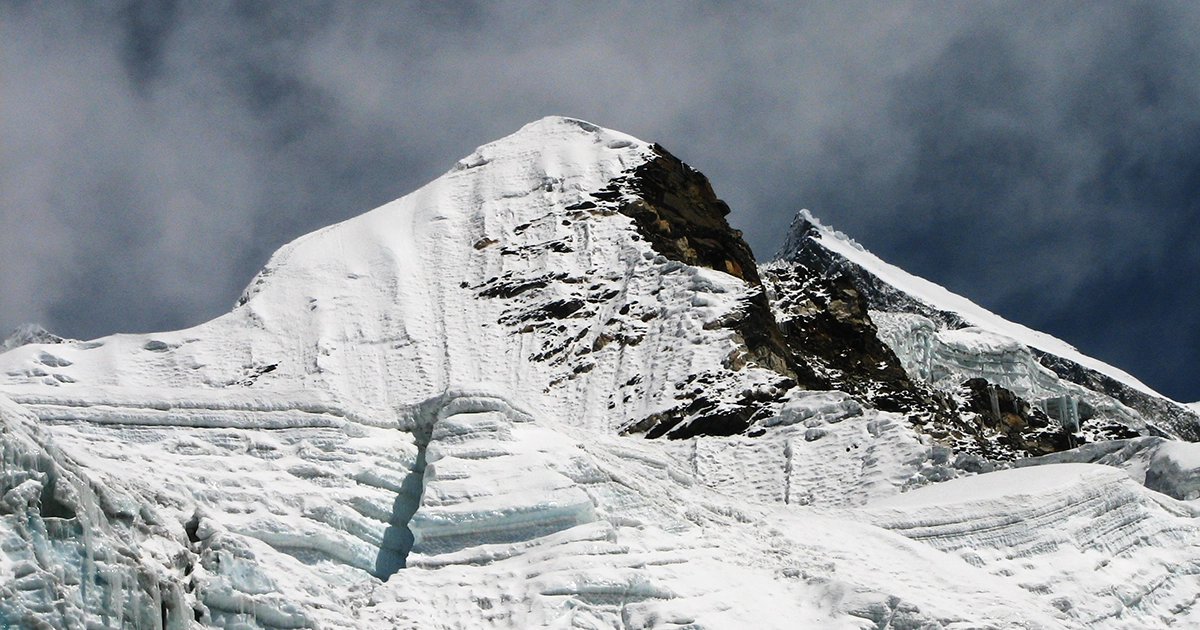
Island Peak can be attempted by fit trekkers who receive basic mountaineering training during the expedition. Lobuche East, however, is generally recommended for climbers who already have experience with alpine climbing or have previously attempted smaller peaks. The technical ridge sections require confidence and balance at high altitude.
In both cases, good cardiovascular fitness and acclimatization are crucial for a safe and successful summit attempt.
Popularity and Success Rate
Island Peak is one of the most frequently climbed trekking peaks in Nepal. Its reputation as a beginner-friendly mountaineering objective attracts many climbers each season.
Because of its popularity, the route is well supported by experienced guides and established camps, which contributes to a relatively high success rate.

Lobuche East sees fewer climbers in comparison. This is partly due to its slightly more technical nature. Climbers seeking a greater challenge often choose it specifically because it is less crowded and offers a more adventurous experience.
Success rates on Lobuche East can vary more widely depending on weather conditions, team experience, and acclimatization.
Costs and Logistics
The logistics for climbing either peak are quite similar since both are located in the same region. A typical expedition includes costs of domestic flight to Lukla, trekking through the Everest region. A typical expedition includes the costs like Domestic flight to Lukla, food and accommodation costs while trekking through the Everest region and other personal expenses.
It also includes the climbing permits issued by the Nepal mountaineering association, the Sagarmatha National park entry permit, Khumbu local municipality permit along with the costs of guides, porters, and climbing equipment.
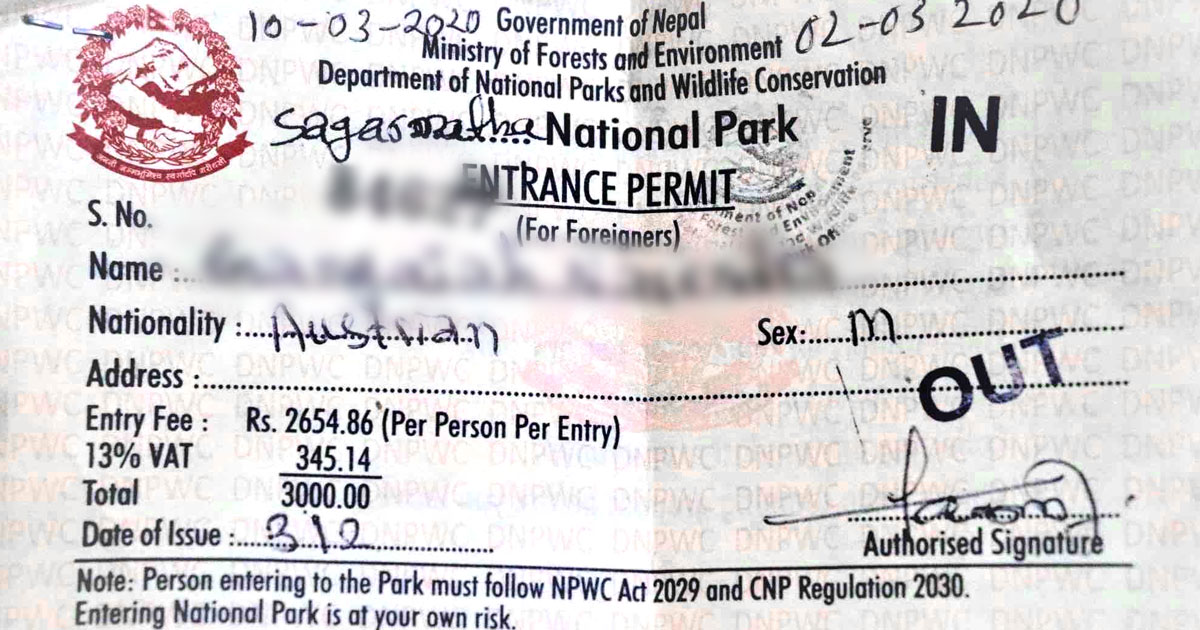
Costs vary depending on the itinerary and service level, but both peaks generally fall within a similar price range. Island Peak expeditions are often slightly more common, which sometimes makes them marginally more affordable due to the availability of established packages.
Best Season to Climb Lobuche East and Island Peak
The best climbing seasons for both peaks are the same as most Himalayan expeditions.
Spring Season (April to May)
Spring is one of the most popular seasons for climbing in the Everest region. Stable weather, warmer temperatures, and clear mountain views make it ideal for high-altitude expeditions.
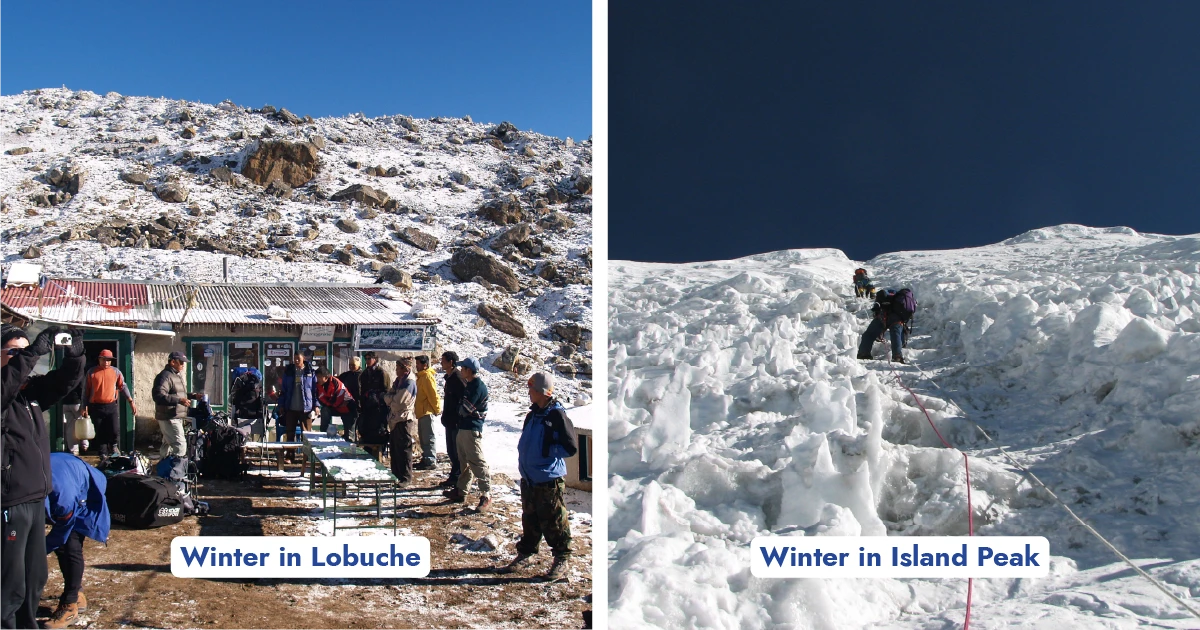
Autumn Season (October to November)
Autumn is another excellent time for climbing. The skies are usually clear after the monsoon season, offering exceptional visibility and stable weather conditions. Winter climbs are possible but extremely cold, while the monsoon season brings heavy snow and unstable weather, making climbing far more challenging.
Pros and Cons of Island Peak and Lobuche East
Every trekking destinations or peaks have their own perks and disadvantages. Here are some of these for Island peak and Lobuche east.
Island Peak
Pros
- Ideal for beginner mountaineers
- Highly popular and well supported
- Classic training climb for larger Himalayan expeditions
- Dramatic glacier scenery
Cons
- Often crowded during peak seasons
- Glacier sections can be physically demanding
- Slightly higher altitude
Lobuche East
Pros
- More technical and rewarding climb
- Less crowded than Island Peak
- Stunning summit ridge with spectacular views
- Excellent preparation for advanced mountaineering
Cons
- Requires stronger technical ability
- Narrow and exposed summit sections
Final Verdict: Lobuche East vs Island Peak, which is Best?
Choosing between Lobuche East and Island Peak ultimately comes down to your experience level, fitness, and mountaineering goals.
If you are a first-time Himalayan climber looking to gain experience with crampons, ropes, and glacier travel, Island Peak is often the better choice. It provides an excellent introduction to high-altitude mountaineering while still delivering the thrill of summiting a 6,000-meter Himalayan peak.
However, if you already have some climbing experience and want a more technical and challenging adventure, Lobuche East may be the more rewarding option. Its exposed ridge and mixed terrain offer a greater sense of achievement for climbers seeking a step up from beginner peaks.
In the end, both mountains provide unforgettable views, thrilling summit experiences, and a chance to immerse yourself in the breathtaking beauty of the Everest region. Whether you choose Island Peak or Lobuche East, the journey through the Khumbu and the moment you stand on the summit will undoubtedly become one of the most memorable adventures of your life.
FAQs
Expand AllIs Lobuche East harder than Island Peak?
Yes, Lobuche East is generally harder than Island Peak. Although slightly lower in elevation, it involves a narrow and exposed summit ridge, steeper sections, and mixed rock-and-ice terrain. Island Peak mainly involves glacier travel and a fixed-rope headwall, making it more beginner-friendly.
Can you climb Island Peak without climbing Lobuche East first?
Yes, Island Peak can be climbed without prior experience on Lobuche East. In fact, many climbers choose Island Peak as their first Himalayan climbing experience because guides provide basic mountaineering training during the expedition.
What is the success rate of Lobuche East 2025?
The success rate for Lobuche East is usually around 60–75%, depending on weather, acclimatization, and climbers’ experience. Proper preparation and good summit conditions significantly improve the chances of success.
How many days to climb Lobuche East vs Island Peak?
Both climbs typically take 16–20 days in total from Kathmandu. This includes trekking through the Everest region, acclimatization days, and time at base or high camp before the summit attempt.
Do you need fixed ropes for Lobuche East?
Yes, fixed ropes are commonly used on steeper sections near the summit, especially on snow and ice slopes. Climbers usually ascend these sections using ascenders for safety.
Island Peak or Lobuche East, which is the best side trip for Everest Base Camp trek?
Both peaks can be combined with the Everest Base Camp trek, but Island Peak is more commonly chosen because it is less technical and better suited for first-time climbers.
How technical is the Lobuche East headwall?
The Lobuche East headwall is moderately technical, with slopes that can reach around 45–50 degrees. Climbers typically use crampons, an ice axe, and fixed ropes to safely ascend this section.
Has anyone died on Lobuche East?
Yes, though rarely. Like many high-altitude mountains, Lobuche East has recorded a few fatalities, usually due to altitude sickness, falls, or extreme weather conditions.
What is the Island Peak difficulty rating 2025?
Island Peak is commonly graded PD and (moderately difficult) on the Alpine scale. Climbers must be comfortable with glacier travel, using crampons, and ascending fixed ropes.
What is the Lobuche East permit cost 2025?
The Lobuche East climbing permit issued by the Nepal Mountaineering Association varies by season. In 2025, the fee is USD 250 in spring (March–May), USD 125 in autumn (September–November), and USD 70 in winter and summer.
Climbers must also pay additional fees such as the Sagarmatha National Park entry permit (about NPR 3,000) and the Khumbu rural municipality permit (around NPR 2,000–3,000).
Can beginners climb Lobuche East?
Beginners can attempt it, but prior mountaineering or high-altitude trekking experience is strongly recommended due to the technical ridge and challenging terrain.
Which is the Island Peak crampon point 2025?
The crampon point is reached shortly after leaving Island Peak Base Camp, where climbers enter the glacier and put on crampons before continuing toward the summit headwall.
Which is better for acclimatization: Lobuche or Island?
Island Peak often allows slightly better acclimatization because climbers spend additional time in the Dingboche and Chhukung areas before the summit push.
How long is the Lobuche East summit ridge?
The summit ridge of Lobuche East is about 100–150 meters long. While not extremely long, it is narrow and exposed, requiring careful movement and sometimes fixed rope support.
Which is the best month for Island peak season 2026?
The best months to climb Island Peak are April–May and October–early November, when weather conditions are generally stable and mountain views are clear.
What is the Lobuche East East Peak vs Main Peak difficulty?
Lobuche East (6,119 m) is a trekking peak open to climbers with permits, while Lobuche West (6,145 m) is far more technical and treated as a full expedition climb.
Do you need ice axe for Island Peak?
Yes, an ice axe is essential equipment for balance, safety, and self-arrest on the snow slopes and summit headwall.
What should be your minimum experience for Lobuche East?
Climbers should ideally have basic mountaineering training and experience trekking above 5,000 meters, along with familiarity with crampons and rope techniques.
How did Island peak new route change in 2026?
The standard route remains largely unchanged in 2025, though guides may adjust sections slightly each season because glaciers shift and crevasses move.
What is the Lobuche east weather in October vs November?
October generally offers slightly warmer temperatures and stable weather, while November is colder but often has clearer skies and fewer climbers, making both months good for climbing.
Related blog posts
Discover a choice of tourist destinations loved by most of our visitors. Whether you're on a jungle safari to spot rare animals or walking through a world heritage site, these well-planned itineraries cover the major highlights of Nepal.
 call an expert at: