
Kailash Mansarovar vs Adi Kailash: What’s the Difference and Which Yatra Should You Choose?
 Amrit K. Aryal
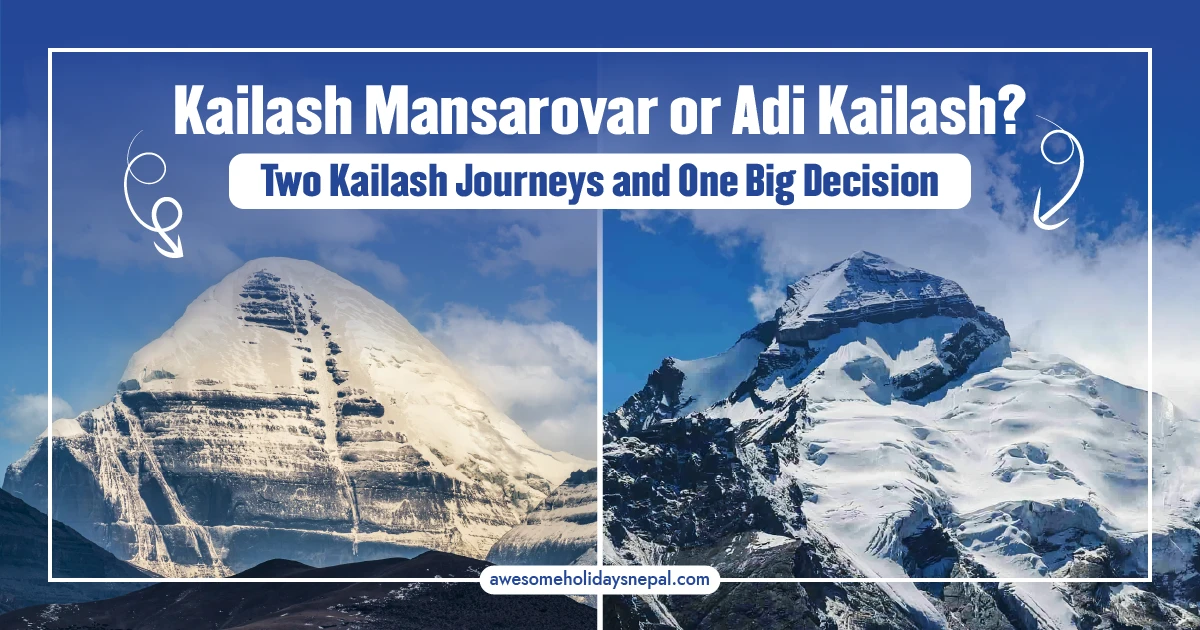
Choosing between Mount Kailash and Adi Kailash is not just a comparison of two mountains and two destinations. It is a decision to choose between two journeys that are of a similar nature.
One is an ancient trail to the original, deeply rooted pilgrimage taking you to Lake Mansarovar and Mount Kailash.
The other is a more recent, accessible path that offers a similar feeling, without the same level of physical and logistical challenge. And if you misunderstand this difference, you may end up choosing a yatra that doesn’t match your intention.
Let us slowly break this difference down in detail.
Known as the Axis Mundi, lying at the center of the earth, Mount Kailash is a peak that is not been climbed by any humans so far, but is circumambulated with faith. Mount Kailash is the abode of Lord Shiva and Mata Parvati. They reside at the peak of Mount Kailash.
It also represents the center of the earth, Mount Meru in Buddhism. The journey to Mount Kailash and Mansarovar is not about sightseeing, but is about completing the Kora or parikrama, a physically demanding circumambulation that carries deep spiritual meaning in the land of Tibet.
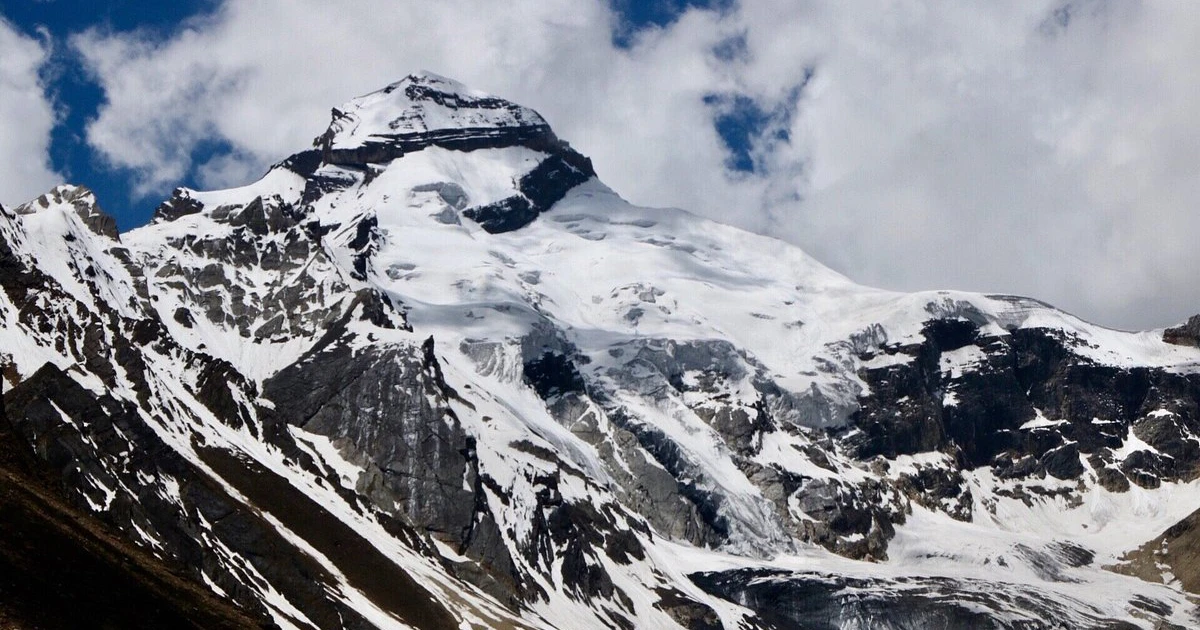
Mount Adi Kailash mirrors the form of Mount Kailash and holds religious importance, but it is not the original site described in ancient scriptures. Here, this distinction matters.
For many pilgrims, who cannot travel to Mount Kailash, the yatra to Adi Kailash is a “visit to Kailash, with the same experience as Kailash.
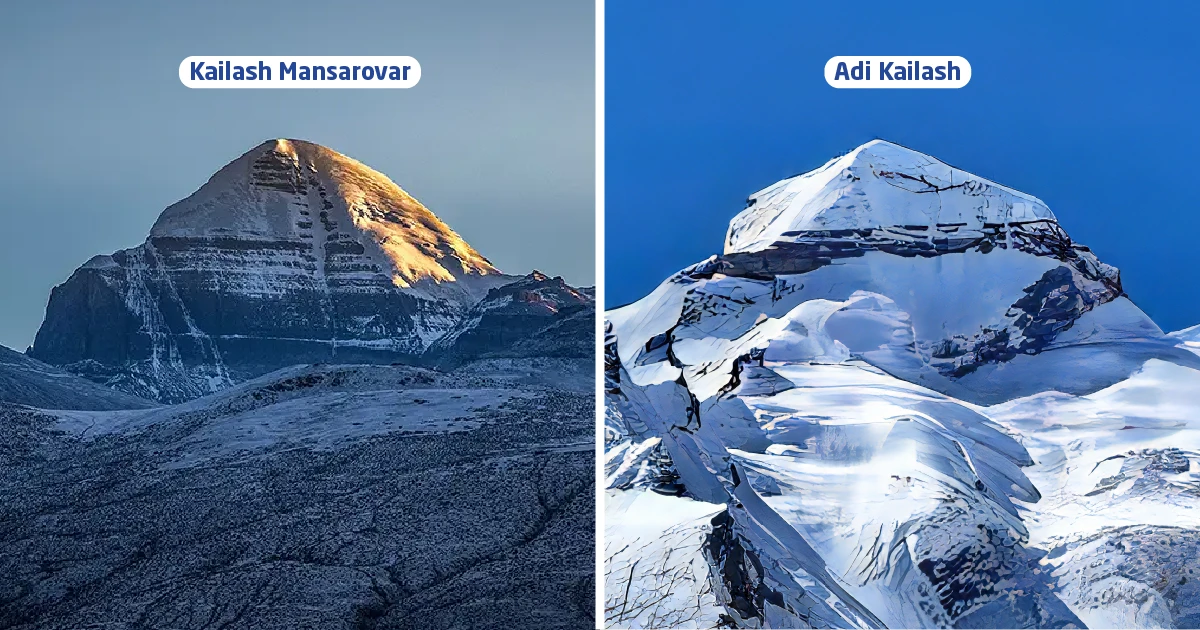
Geographical Location and Accessibility: Tibet vs India
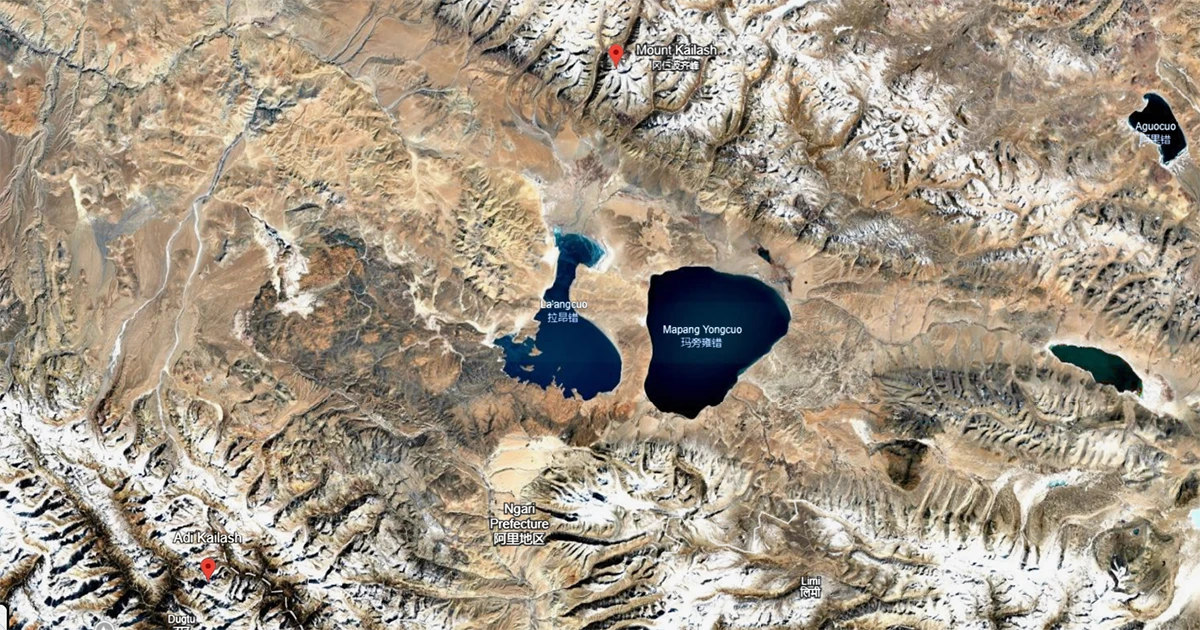
The geographical location of these two mountains offers different experiences. One mountain, Kailash Parvat, lies in the remote part of Tibet in the Ngari prefecture of China. One of the freshwater lakes at the highest altitude, Lake Mansarovar, also lies in the lap of the mountain.
On the other hand, Adi Kailash, located in India, is often referred to as Chhota Kailash. It is located in the Pithoragarh district of Uttarakhand, near the Indo-Tibet border at an altitude of 5,945 m, in the Kumaon Himalayas.
This fundamental difference is the foundation for different experiences at the two trekking destinations.
A trip to Mount Kailash involves an international arrangement, high altitude terrain, and a trip to Adi Kailash involves a shorter domestic trip to Uttarakhanda, with easier logistics.
Spiritual Experience: Depth, Immersion, and Personal Transformation
The comparison between the mountains can be done in various ways. Either from a geographical aspect or a technical point of view, the journey becomes less technical and more personal.
Kailash Mansarovar Yatra Experience
The journey to Kailash Mansarovar Yatra unfolds in various stages:
- Acclimatization across high-altitude terrain throughout the trail.
- Darshan and the circumambulation of Lake Manasarovar.
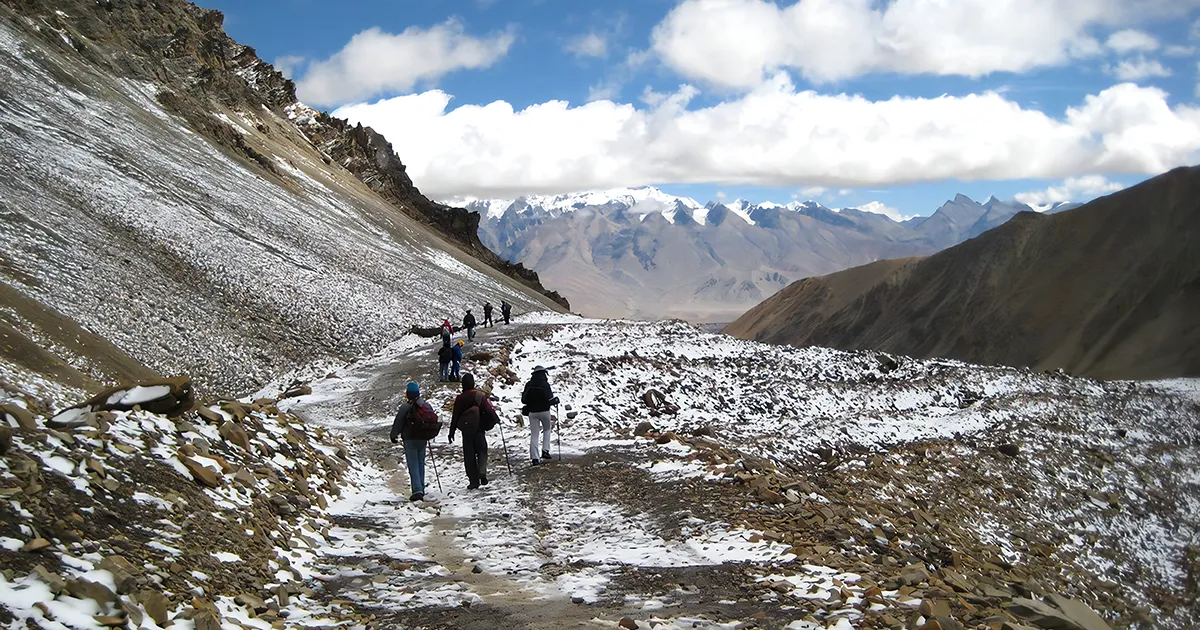
- Trek for three days, cross the Dolma La Pass above 5,600m, completing the Kailash Kora.
The physical intensity, combined with isolation and altitude, creates a space where pilgrims often describe mental clarity, emotional release, and deep introspection. The trek to Dolma La pass is often not considered comfortable. Difficult trek, long hours of walking, and discomfort are a part of its transformative nature.
Adi Kailash Yatra Experience
While trekking to Adi Kailash, the experience is more grounded and less physical challenges. Indian people often visit Om Parvat, Parvati Sarovar, Char Dham, and other sacred places.
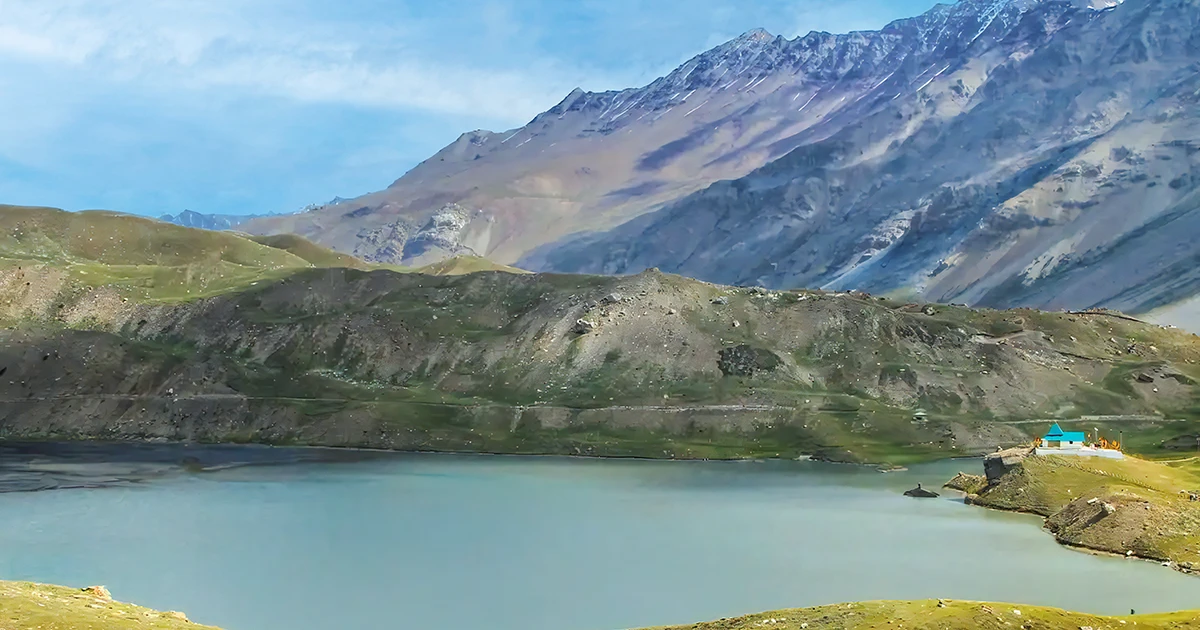
Sacred viewpoints of Adi Kailash
Trek to Adi Kaialsh is full of devotion and beauty. Not all the mountains demand the same level of surrender or physical difficulty. The trek feels more spiritual and a retreat than a test.
Difficulty and Physical Demands: What Are You Really Signing Up For?
This is where the emotional idea of a yatra meets reality. Because no matter how spiritual the intention is, your body still has to go through it.
Kailash Mansarovar Yatra: A Test of Endurance
The journey to Mount Kailash is physically demanding, and there is no shortcut to cross the Dolma La Pass.
- The highest altitude reaches beyond 5,600 meters at the Dolma La Pass.
- The thin air drops the Oxygen levels significantly
- The Kora involves 3 days of trekking in harsh terrain
- The weather changes quickly, sometimes within hours
The trek to the mountain is not a comfortable journey, never was, and never going to be. Fighting against gravity and low oxygen is not easy. There is a reason why pilgrims prepare for months, including walking practice, breathing control, and mental readiness.
You cannot start practising as you approach the mountain. You cannot rush it, you cannot escape. You need to move slowly and listen to the rhythm of your body. Every discomfort is replied by the body in a different tone. All you have to do is acclimate, rest, and drink enough water. Because, somewhere in that discomfort, something shifts.
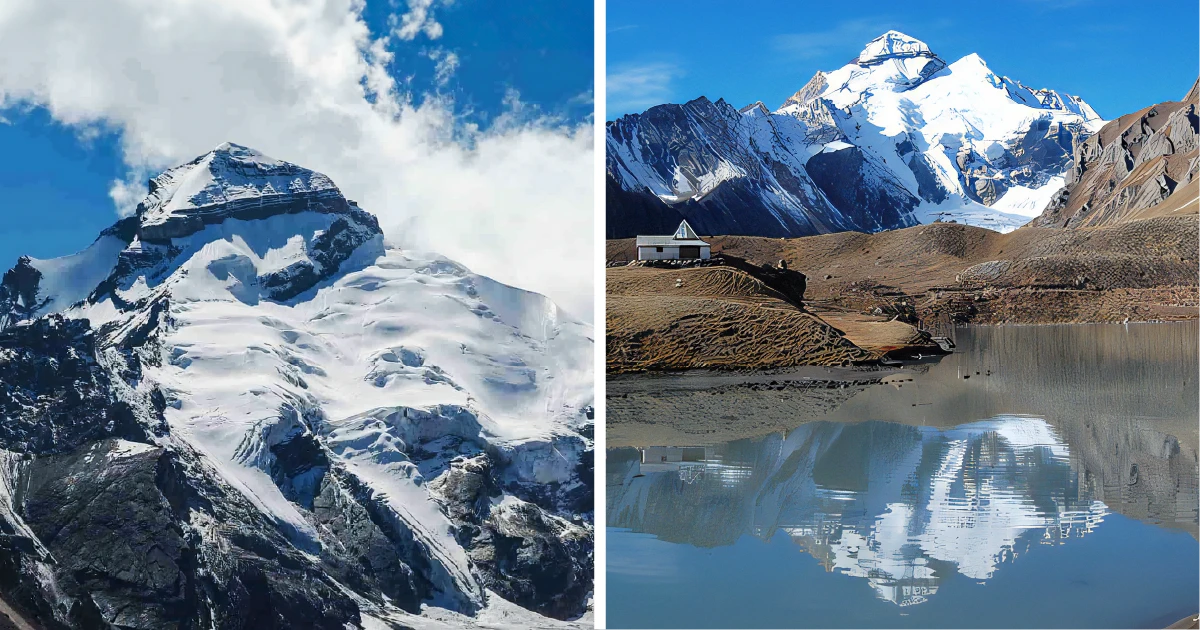
Adi Kailash Yatra: Controlled Challenge, Not Extreme
The journey to Adi Kailash is a bit easier and different in this aspect. The lower altitude exposure compared to Kailash Mansarovar allows a lower risk of altitude sickness. Another good part of the trail is that most of the parts of the route are now accessible by vehicle, and short walking distances. The region around Pithoragarh has seen infrastructure development in recent years, making the yatra more accessible than before. This doesn’t mean walking the trails is effortless, but it is more accessible, predictable, and manageable.
Route and Travel Experience: Remote Expedition vs Himalayan Circuit
Kailash Mansarovar Route (via Nepal and Tibet)
The Kailash Mansarovar Yatra is operated via Nepal. Pilgrims must apply for the permits and visa via a registered trekking company in Nepal.
The package includes an overland journey via the Hilsa or Kerung border to China. The road is smooth with a gradual gain in height, providing proper acclimatization. The route passes through the vast, open landscapes, but for a long stretch, completely silent, good for a spiritual journey.
Driving for days, you finally reach Lake Manasarovar for the spiritual rituals, taking a bath and performing puja for karmic purification.

Adi Kailash Route (Kumaon Himalayas, India)
The journey to Adi Kailash feels more like a Himalayan road expedition. The typical route to Adi Kailash includes Kathgodam / Haldwani → Dharchula → Gunji → Nabi → Kuti → Visits to Om Parvat →Parvati Sarovar near Adi Kailash.
This route passes through villages, forests, and river valleys, and makes you feel connected to life, not isolated from it.
| Aspect | Mount Kailash (Kailash Mansarovar Yatra) | Adi Kailash (Adi Kailash Yatra) |
| Spiritual Significance | Original, ancient pilgrimage site; considered the abode of Lord Shiva | Symbolic or “Chhota Kailash”; spiritually important but not original |
| Location | Tibet (China) | Uttarakhand, India |
| Coordinate | 30°20′ N, 80°25′ E | 31°04′ N, 81°18′ E |
| Type of Experience | Intense, transformative, deeply immersive | Calm, accessible, retreat-like spiritual journey |
| Main Ritual | 3-day Kora (parikrama) around Mount Kailash | Darshan of Adi Kailash, Om Parvat, and Parvati Sarovar |
| Nearby Attractions | Om Parvat, Jolingkong Lake, Gunji Village, Kuti Village | Yam Dwar (Tarboche Flagpole), Diraphuk Monastery, Zuthulphuk Monastery |
| Altitude | nearly 5,600 meters, Dolma La Pass | Lower altitude, 5,245 meters |
| Difficulty Level | High (physically and mentally demanding) | Moderate (manageable for most travelers) |
| Travel Duration | 10–14 days (average) | 5–7 days (average) |
| Route Type | International (via Nepal → Tibet) | Domestic (within India) via the Pithoragarh region) |
| Permits Required | Chinese visa and Restricted Permits | Special Permit |
| Cost Range | High (premium for pilgrimage Tour) | Moderate to low (budget-friendly and high-end) |
| Accessibility | Limited, fixed departures, group travel, and Heli Tour | Flexible, improved road connectivity |
| Suitable for Seniors | Possible with preparation, but challenging | More suitable and safer option |
| Overall Feeling | A once-in-a-lifetime, complete pilgrimage | A meaningful but lighter spiritual journey |
| Number of Rivers Originating Nearby | No major river | Four major rivers: Sutlej, Brahmaputra, Karnali, and Indus |
FAQs
Expand AllAre Kailash Mansarovar and Adi Kailash the same place?
No, Mount Kailash and Adi Kailash are not the same. Mount Kailash is a sacred mountain located in Tibet, while Adi Kailash is a mountain that looks like Mount Kailash, situated in India.
Is Adi Kailash the same as Mount Kailash?
No. Adi Kailash resembles Mount Kailash in appearance and spiritual symbolism, but it is not the same location or the original pilgrimage site.
What is the actual difference between Kailash Mansarovar and Adi Kailash?
The main difference between Mount Kailash and Adi Kailash is the location. The real Kailash lies in India and the replica Adi Kailash is situated in India.
Why do people compare Adi Kailash with Kailash Mansarovar?
It is because Adi Kailash resembles Mount Kailash in shape and looks and also offers a similar spiritual setting, especially for those who cannot travel to Tibet.
Which yatra should I choose: Kailash Mansarovar or Adi Kailash?
The choice depends on your purpose of the journey. If you want a full spiritual and challenging and adventurous journey, then Kaialsh Mansarovvar yatra is good for you. And you can opt for Adi Kailash if you prefer a shorter, easier, and more accessible journey.
Which yatra should I prioritise if I may only do one in my lifetime?
If you are physically prepared and able to manage the logistics, most pilgrims prioritise Mount Kailash, as it is considered the original and complete yatra.
Which yatra should I prioritise if I may only do one in my lifetime?
If you are physically and mentally prepared, with proper arrangement of logistics, it is recommended to go for Mount Kailash Yatra.
Is Adi Kailash a substitute for Kailash Mansarovar?
Spiritually, people consider Adi Kailash as an alternative to Mount Kailash. But, physically, no one can be the complete compensation for each other. Each of them has its own significance.
Which one is better for first time pilgrims?
For first time travelers, Adi Kailash is a better option due to its lower difficulty and simpler logistics.
Which one is more suitable for older travellers?
Adi Kailash could be the better choice for elderly pilgrims due to less difficulty of the trail, lower altitude and reduced physical strain. However, experienced and prepared older pilgrims do complete Mount Kailash successfully.
Which one is better if I have limited time?
With limited time, Adi Kailash is the better option taking only 5–7 days, while KAialsh Mansarovar Yatra takes 10–14 days.
Which one is easier physically?
Trip to Kailash is significantly easier, with lower altitude and shorter trekking sections. Pilgrims from India often prefer going to Adi Kailash due to easier logistics.
Related blog posts
Discover a choice of tourist destinations loved by most of our visitors. Whether you're on a jungle safari to spot rare animals or walking through a world heritage site, these well-planned itineraries cover the major highlights of Nepal.



 call an expert at: