
The Four Faces of Mount Kailash and Their Deep Spiritual Meaning
 Amrit K. Aryal
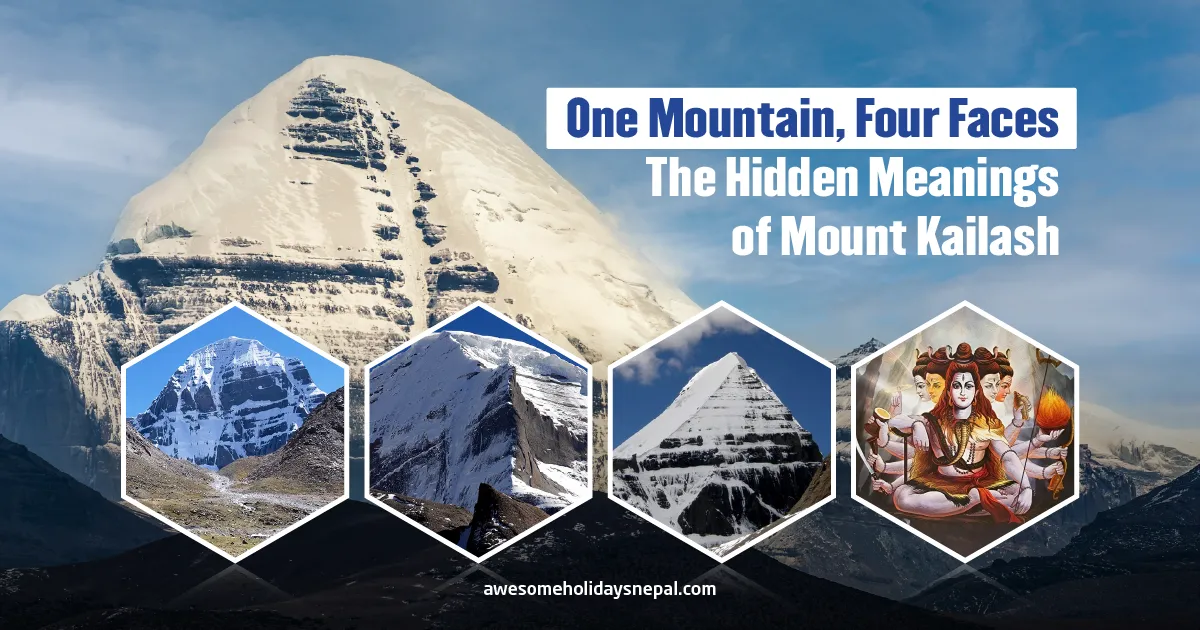
Gaze onto the faces of Mount Kailash long enough, and it starts to take the form of a giant pyramid built before time remembered itself. Four faces cut with impossible precision, north, south, east, west, each rising like a wall of silence.
Some say it is nature’s design, while others whisper it’s something older, not man-made, not quite earthly. The slopes of Mount Kailash on the Trans-Himalaya meet at a perfect point, an ancient geometry chiseled by gods. Each face glows differently, turning golden at sunrise, silver at dawn, blue steel at noon, fire at sunset.
You can circumambulate around it, but never climb it. Maybe that’s what Shiva wants. Maybe sacred mountains like Kailash are not meant to be conquered but to be perceived, one face at a time.
Meaning of the Four Faces of Mount Kailash
The four faces in four directions of Kailash Parvat are not just compass points. These faces are the moods of the same spirit. The east face wakes first, golden, soft, like the world taking its first breath. The south feels warmer, more alive, almost human, carrying stories of kindness and creation. The west turns quiet when the sun folds away, a kind of memory for eternity.
People say that’s where liberation hides, in the north of Kailash. Together, these four faces of Kailash just do not resemble directions, but a spiritual symbol of birth, living, fading, and release. Maybe that’s what makes the Kailash mountain feel alive.
South Face of Mount Kailash: The Lapis Lazuli Face of Splendor
On the first day of Kailash Parikrama, the Kailash Mansarovar pilgrimage starts at Darchen. The air is thin and already affecting your lungs. As you start walking from Yamadwar toward Kailash Mansarovar, you feel the aura. From Yamadwar, you can see the south face of Kailash for the rest of the day. From there, we make a round trip to Kailash Parvat towards the west and then to the north face of Kailash.

It is said that the south face of Kailash Parvat is made of Lapis Lazuli, a deep blue rock from the metamorphic class. As mentioned in old test books, this colour of the mineral represents the silence of the vast sky above Kailash. As the first light of the day falls onto it, it holds the majestic form where snow retains like light on truth.
The Sacred Meaning of the South Face of Sacred Mount Kailash
The Lapis Lazuli Face, as popularly said to hold the wisdom and peace as if Lord Shiva himself is in his deep meditation. The sharp razors of the mountain blue stand for the purity and divinity of Lord Shankar. The mix of black and white rocks, the blue of the lapis lazuli crystal, and the silence of the cold, gives an appearance of Shiva himself. Many pilgrims have noticed a face, resembling the face of Lord Shiva, hidden in the snow and rock. This face hits you hard into your imagination of endless time.
Beliefs and Layers
The long vertical spine-like structure runs from the top to the bottom of the mountain. This vertical structure is seen as the spine of Lord Shiva. Some also write it as the third eye, the cosmic symbol of destruction. For Buddhists, it’s a symbol of a mind full of compassion and wisdom without limitations. Again, for followers of Bon, the spine-like structure represents a gateway to a higher world of liberalization. Many of them also connect the southern face of Kailash Parvat with the earth element, steady and unshakable.
Where to See It
Rakshastal, the twin lake of Lake Mansarovar, is the first place where you will have your first glimpse of the South face. As you go closer to Lake Mansarovar, the view of the south face becomes magnified. As you reach Yamadwar, get a pause, stand, and whisper some prayers as you look into the south face. During the summer, the snow melts, making the spine look wider and clearer. This is the path of divine energy that goes directly to the peak of Mount Kaialsh, calling Aatmalingam flowing through Shiva’s own spine.
Vishnu Dharmottara Purana, an ancient scripture, has described five faces of Lord Shiva. Four of the faces are calmer, but the south face, Agora, is fierce. Aghora’s face is so terrifying that even the lord of death fierce of it.
West Face of Mount Kailash: The Ruby Face of Compassion
As you move slowly from Yamadwar to Dhiraphuk 4,890 m, you get close to the west face of Mount Kailash. You see the west face long before you realise that the journey has truly begun. The silent giant on the west is turning red as the first rays fall on the west face of Kailash.
Different from the South and the North faces hidden in the shadow, the west face is half exposed and silently watching your determination. After 12 km from Yamadwar, there lies Darchen, your first accommodation for the Kailash Kora.
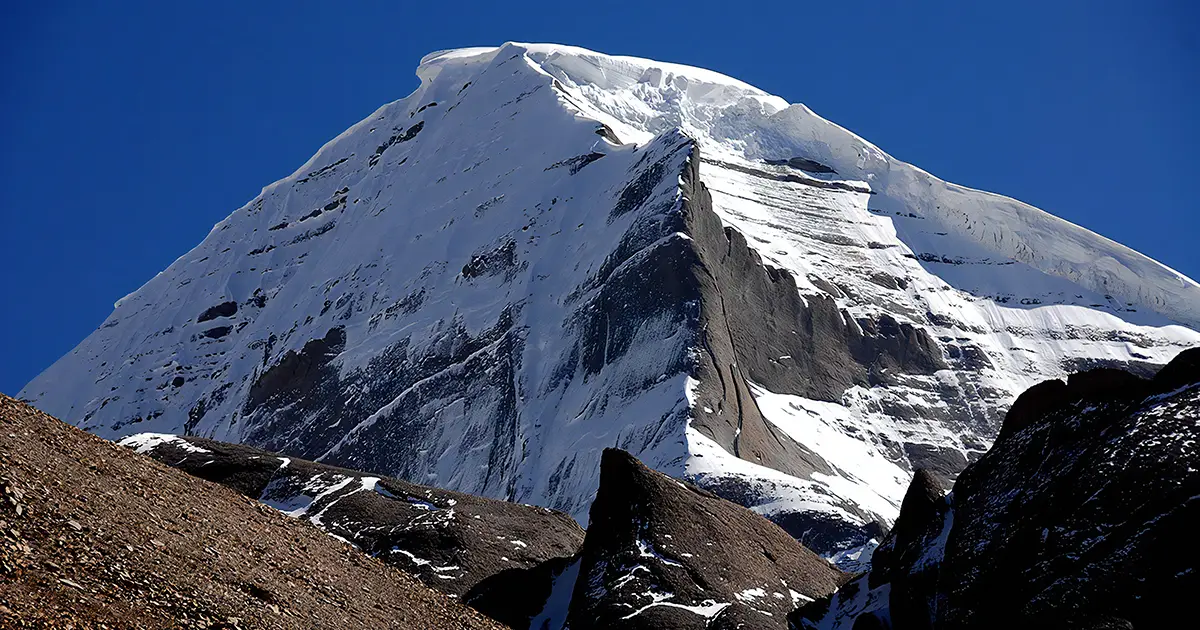
The Karnali River flows clear as crystal, carrying whispers of the chantings from pilgrims and devotees.
A Mystic Face
Many of them have seen a clear human face on the west face, maybe the face of Lord Shiva. As you observe closely, you can clearly see the eyes, nose, and lips carved on the rock of Kailash Parvat. Staring for a long time, some have felt a larger image giving a strange feeling of some ancient energy, giving a glaze upon you, which may not be described by words. There’s awe, a bit of fear, a strong pump in the chest. This could be a perfect place to sit quietly and meditate under the shadow of the west face.
The Ruby Face of Compassion
Describe as the ruby face, a face of divine love and protection. The red gems of courage, blood, and heart carry the warmer tone of the magnificent energy of Sadyojata. The west face of Lord Shiva also symbolises creation. Ruby red is associated with the Muladhar chakra. As the light kisses the ruby, the reddish hue is believed to activate your root Muladhar chakra, or the root chakra. I have seen some of them weeping with the joy of being lost in the vast emptiness.
Beliefs and Science
Astrologists say that the west direction is ruled by Varun dev, the Lord of the water element. West is the entrance for emotion, purification, and surrender. Pilgrims often face this direction to chant, pray, or practice Anuloma Vilom pranayama.
North Face of Mount Kailash: The Golden Face of Power
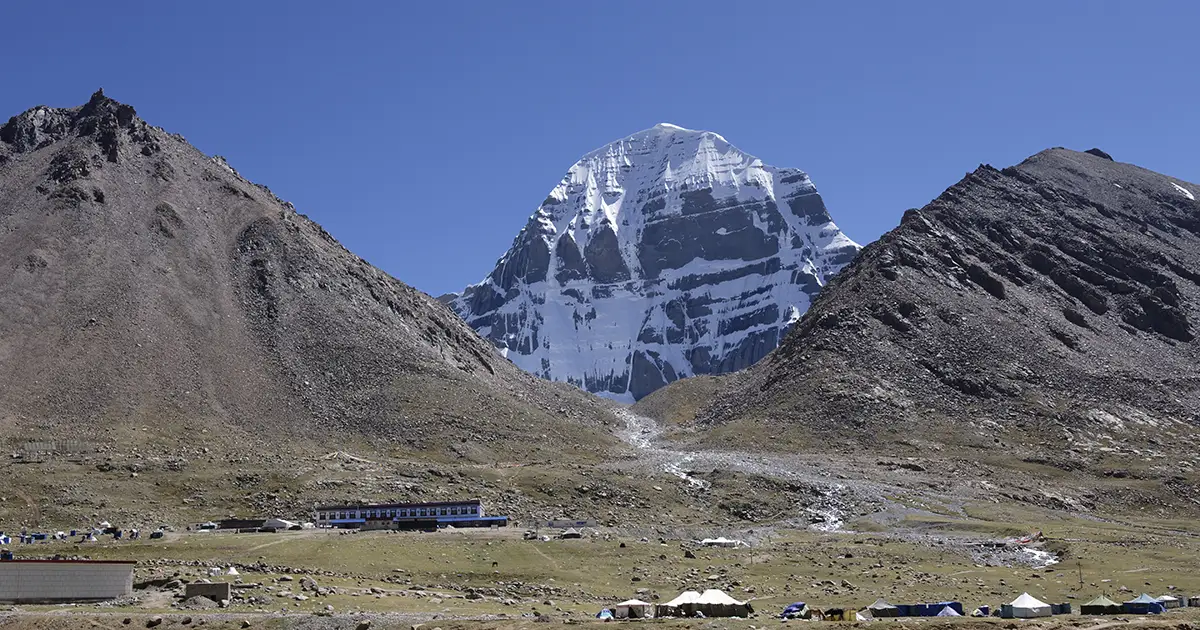
The most popular, most talked most seen face of Kailash is the north face of Kailash. This is the face of Kailash that is most pictured in magazines, blogs, and prayer walls. Unless you stand before the north face, you cannot feel the mountains alive. The picture is not just a still but a life itself.
On the way to Diraphuk, the very first day of Kailash Parikrama, when the air gets thinner, the earth turns higher, and there you see the north face, hidden behind two mountains. They call it the Golden Kailash when the sunlight hits, and call it Silver Kailash when it reflects the light of the full moon. The colour of Kailash changes with light, your steps, your breadth, and your faith.
The Face That Watches and Teaches
You might have heard of the charan sparsh, via the Astapad, though not permitted now, get a closer view of the North face. Some people can feel the outline of Shiva himself, but the camera cannot really capture it. This is a feeling only a pure heart of devotion can see.
The Golden Face of Power
For Hindus, the North face holds the energy of Vamadeva, the face of preservation. For Buddhists, the north side holds protectors and guardians of Dharma, wrathful deities, and guardians of awakening. So, the north face is the face of transformation.
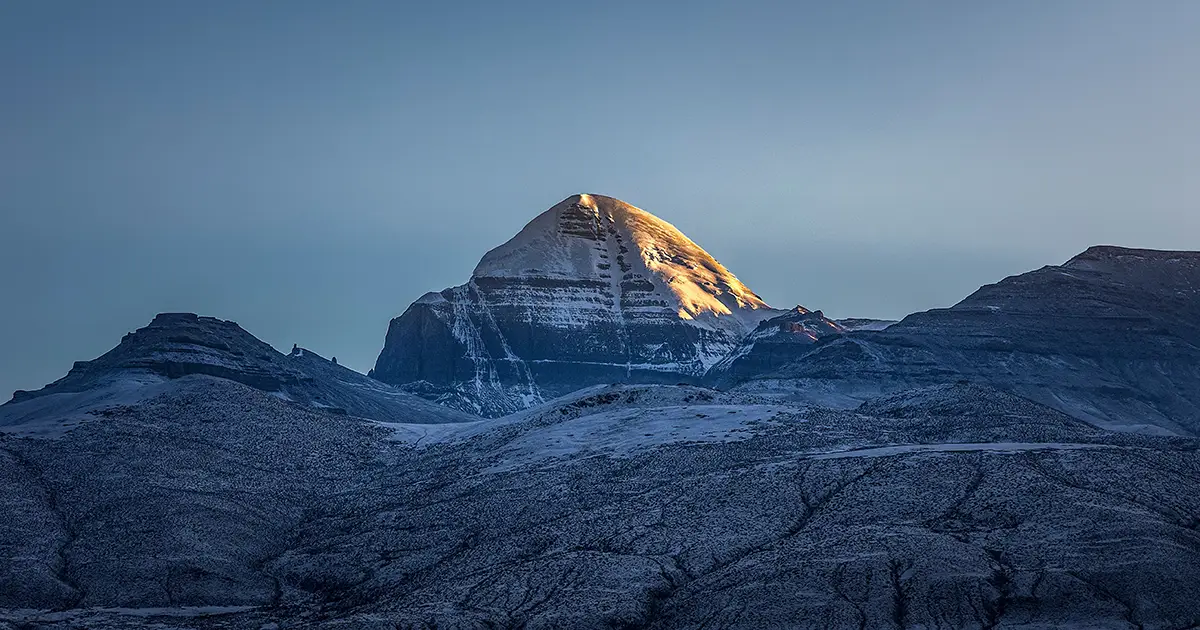
The East Face of Mount Kailash: The Crystal Face of Mystery
Also known as the crystal face, the Eastern Face of Mount Kailash is the symbol of purity and clarity. East is the direction of mystery ruled by Indra. The east face of Kailash is visible during your second day. As pilgrims descend from Drolma La (Dolma La- 5,630 meters) pass to Zuthulpuk and approach the Gauri Kunda, the view of the east face becomes momentarily visible.
To the east of Mount Kailash, there is Gauri Kunda, where Hindus believe Mata Parvati gave birth to Lord Ganesh. The myth says that Mata Parvati went for a meditation, and Ganesh was at the gate. When Lord Shiva came to visit Parvati, Ganesh stopped him without knowing who he was. On fierce, Shiva chopped his head. Later, Shiva joined the head of an elephant and brought him alive with his magical power. During your Kailash Kora, you get to cross the highest Drolma La and Gauri Kunda.
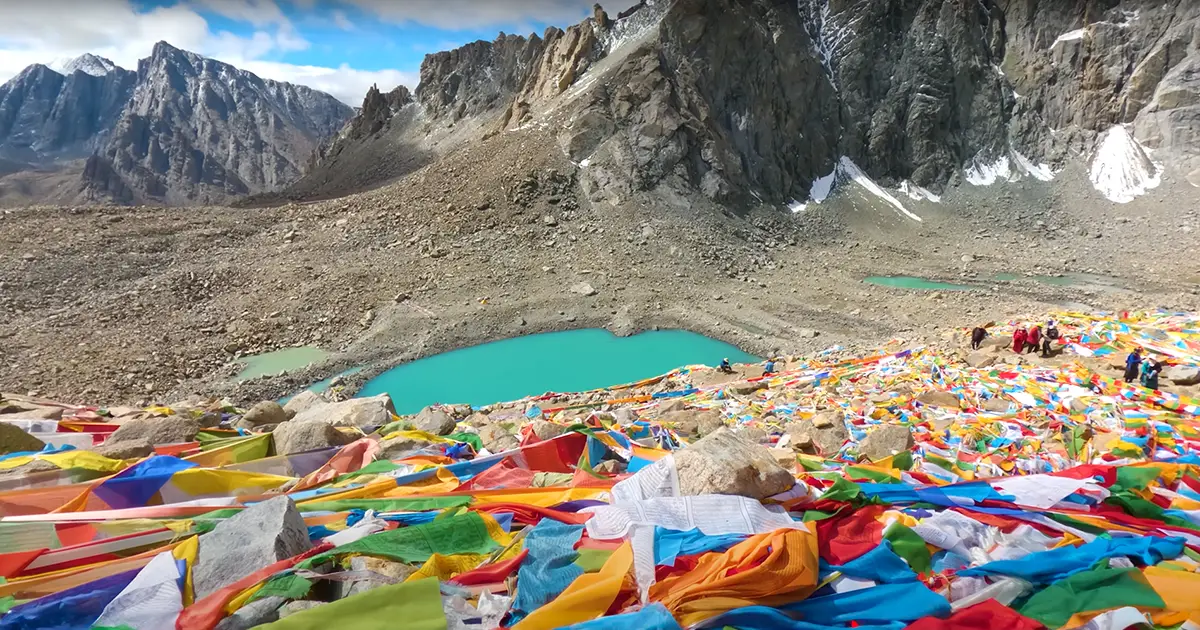
The clear and close views of the East Face of Kailash are observed during the Inner Parikrama. But, for the time being, the inner kora has been restricted for security reasons by the Chinese Government.
Visual Characteristics of the East Face
East is the direction of inner divine sight in search of the ultimate truth. White crystal symbolizes a clear mind, a pure heart, and the untainted light of awakened awareness. It is the face of pure, clear, awakened consciousness and spiritual vision. The East Face also clears the properties of a human mind that an individual can attain higher spiritual consciousness.
The Five Faces of Shiva
Even though the geometry of Kailash shows four faces, the religious myths suggest the mighty lord Shiva has five faces. And each of these faces represent a different thing. Here’s a little description on that:
- Aghora (South Face) is associated with Dissolution.
- Sadyojata (West Face) represents creation.
- Vamadeva (North Face) represents preservation.
- Tatpurusha (East Face) is related to embodying Concealment.
- Ishana (Zenith Face) represents grace.
Visit Kailash to witness this magical beauty of Shiva!
FAQs
Expand AllWhat do the four faces of Mount Kailash represent?
Each face of Mount Kailash has a deep, hidden meaning, not just a direction. They secretly explain the cycles of life from birth to the door of liberation.
Why is Mount Kailash sacred in four religions?
Mount Kailash is sacred to four major religions in the world. For Hindus, it’s the home of Lord Shiva and his family. For Buddhists, it is their sacred Mount Meru, the central axis of their world. For Jains, their first Tirthankar Rishavdev got enlightenment. And for Tibetan Bonpos, it is the mountain where heaven unions with earth.
What is the spiritual meaning of Mount Kailash’s north face?
The North face of Kailash is the most popular face, often photographed, featured in magazines, and on wallpaper. The North Face is also popular as the Golden Face. The north face is believed to hold the energy of moksha, representing spiritual freedom.
How do Hindus interpret Mount Kailash’s faces?
Hindus often compare the faces of Mount Kailash with the faces and names of Lord Shiva. These faces are said to carry his four moods, namely creation, destruction, meditation, and silence. For them, Kailash is the abode of Lord Shivaa, and these four sides of Kailash reflect his moods.
What does the east face of Mount Kailash symbolize in Buddhism?
In Buddhist scriptures, Mount Kailash is known as Mount Meru. The eastern crystal face of Kailash is the representation of a mysterious symbolizing origin, clarity, and the dawn of spiritual awakening. This is the reason why monks always meditate facing the east.
Is Mount Kailash really shaped like a pyramid?
Mount Kailash looks like a giant pyramid not made by man. Kailash holds four symmetrical faces and gives the shape of a perfect pyramid.
Why can’t you climb Mount Kailash?
Climbing Mount Kailash is not possible for many reasons. Locals believe that the mountain holds spiritual energy. So, people forbade climbing to protect the sacred energy of the mountain. In the 19th century, some mountaineers tried to ascend it, but returned with mysterious energy pulling them back.
What are the colors associated with each face of Mount Kailash?
Each of the faces of Kailsh is associated with some colours. The eastern side shines white crystal, the south shines blue of Lapis Lazuli, the west turns ruby red when the sun shines, and the north stays golden. These different colours are the reflection of the moods of the same soul.
Does Mount Kailash change appearance from different angles?
Yes, the mountains look different from different angles. Mount Kailash looks calm from some angles and looks sharp and tall from some Valleys. The falling of light at different times of the day also changes the appearance of Mount Kaialsh.
What is the Jain perspective on Mount Kailash’s four sides?
For Jains, Ashtapada is the spot where their first tirthankar Rishavdev got enlightened. This is the place where the Jain religion was born.
How do Bonpo followers view Mount Kailash’s structure?
For Bonpo, this mountain is the nine-story Swastika Mountain, often referred to as Yungdrung Gutsek. This is a symbol of the eternal cycle, and the four faces of Kailash are symbols of the four elements, the four winds, and the balance between the positive and negative energy.
Are there any scientific studies on Mount Kailash’s symmetry?
Some geologists and scientists have tried to measure angles, lines, rocks, and layers. They also tried to study the tectonic movement of the plates underneath. But no concrete result has been published, and it is full of mysteries and puzzles.
Can you see all four faces of Mount Kailash during Kora?
Yes, we can see all four faces of Kailash, but not on a single day. As we walk around Kailash for the next three days, we will observe different faces from different places.
Is Mount Kailash considered the axis mundi?
Yes, Mount Kailash is called Axis Mundi, the spiritual axis of the world, an axis that is balancing the rotation of the earth. At this point, the earth, the heaven, and the sky meet.
Related blog posts
Discover a choice of tourist destinations loved by most of our visitors. Whether you're on a jungle safari to spot rare animals or walking through a world heritage site, these well-planned itineraries cover the major highlights of Nepal.
 call an expert at: