
Rhododendron in Nepal: A Treasured Flower Beholding the Country’s Identity
 Amrit K. Aryal
Trekking in Nepal is the best way to experience the country’s rich biodiversity. If you plan one for the summer, the trails to your trekking destination will most likely pass through dense rhododendron forests. But do you know that the rhododendron in Nepal isn’t just a mere plant but also holds the value of the country’s identity?
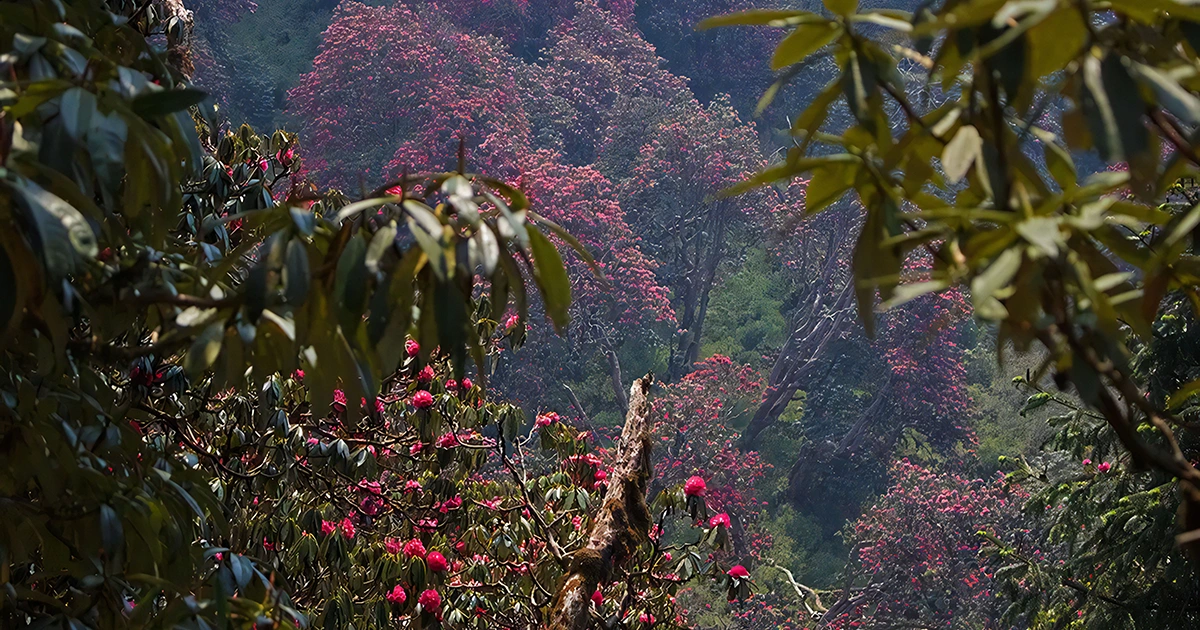
Yes, you heard it right! Rhododendron is Nepal’s national flower, and it’s exclusively found in the country. The blooming of these bright red flowers signals the arrival of spring in Nepal, attracting visitors to the hills to admire the flowering trees.
Besides, Nepal is also home to the world’s largest rhododendron forest. This forest lies in the Ghorepani-Poonhill region within the Annapurna Conservation Area. Since Maurice Herzog and Louis Lachenal climbed Mount Annapurna in the 1950s, this region has become popular for its stunning landscapes, diverse flora and fauna, and rich cultural immersion.
Let’s dig deeper into the essence and occurrence of Rhododendron in Nepal.
Everything About Rhododendron in Nepal
National Flower of Nepal
The rhododendron, known as Lali Guras (लाली गुँरास) in the local language, was declared the national flower of Nepal in 1962. This particular species is Rhododendron arboreum, whose tree can grow up to 20 m tall.
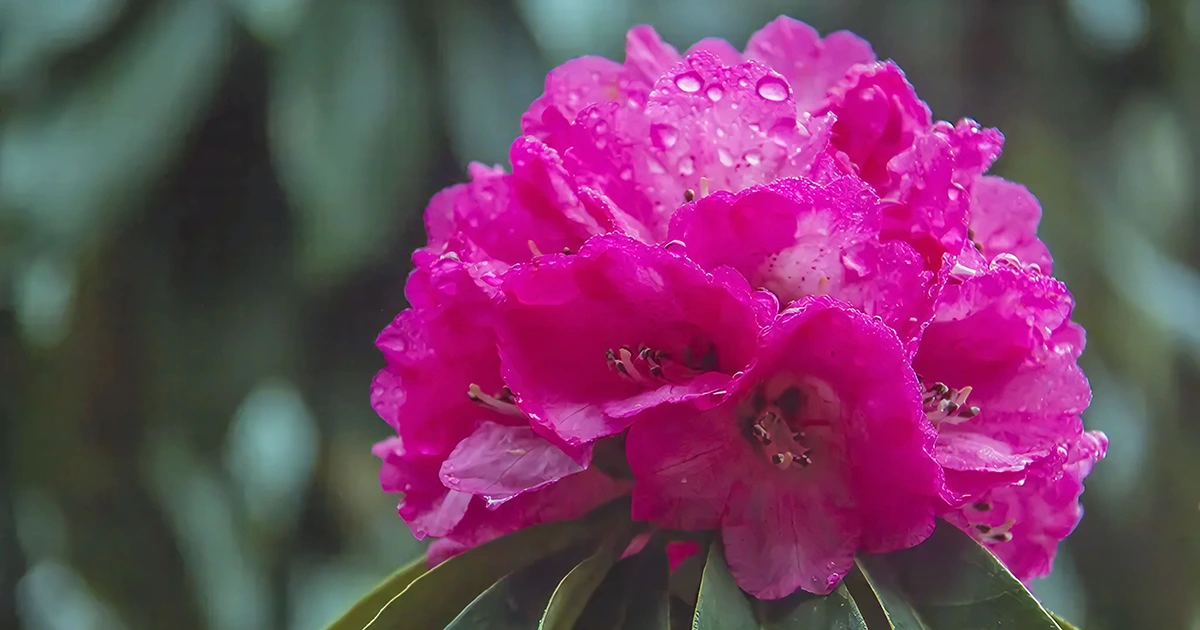
The rhododendron plant holds exceptional value among the Nepalese because different species grow throughout the country. The crimson color is also the base of the national flag of Nepal and symbolizes victory, resilience, and the vibrant spirit of the people.
Why is Rhododendron Popular in Nepal?
Though rhododendrons have different colors, the most distinguished are red, maroon, white, yellow, and pink. Most people think that only the red one is a rhododendron, as it is the most commonly found throughout the hills of Nepal from east to west.
People have found various uses for the flower. The petals can be eaten raw, fermented into pickles, or infused with alcohol. The dried petals can be used as tea or chewed to treat dysentery.
The flower also has medicinal value that can treat cardiac disease, inflammation, constipation, bronchitis, and asthma. According to WHO (2000), about 65% of the global population uses the medicinal value of the rhododendron plant as a painkiller, antifungal, antioxidant, and antimicrobial.
However, not all rhododendrons are suitable for consumption, as some species have toxic nectar. The young leaves can be used to prepare fish poison, and the juice is used to treat bed bugs.
Rhododendron Forests: Where to Spot Crimson Blossoms?
Every traveler on Nepal’s trekking routes may be interested in spotting rhododendrons. All the hiking trails around Kathmandu Valley, Pokhara, and the trekking routes of Nepal pass through the stunning backdrop of this vibrant, lush forest of rhododendrons along the trekking routes of Annapurna Base Camp and Annapurna Circuit.
Moreover, the Ghandruk-Poon Hill areas have the densest forest, allowing the most romantic rhododendron view trek in the Ghorepani-Poon Hill Trek.
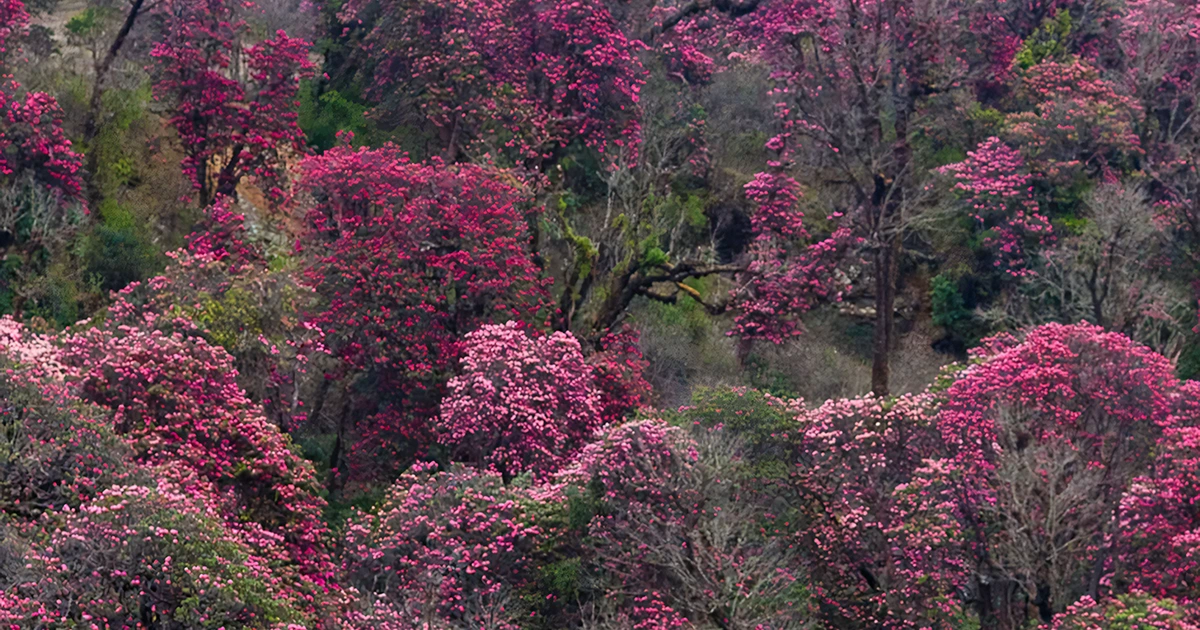
Many Rhododendron species can be seen during the Langtang Valley Trek, Lower Everest Region Trek, Makalu Barun Valley Trek, and Mardi Himal Trek. Although this most attractive and diverse species is found throughout Nepal’s hilly region, adequate rhododendron species are found predominantly in Teenjura, Milke, and Jajale, also known as the TMJ region. Hence, this region is known as the Rhododendron Capital of the nation and was declared a rhododendron conservation area in 1998.
During this trek, you will also see the beautiful peaks of the region, in addition to the attraction of rhododendron flowers.
A Blooming Paradise in the Himalayas
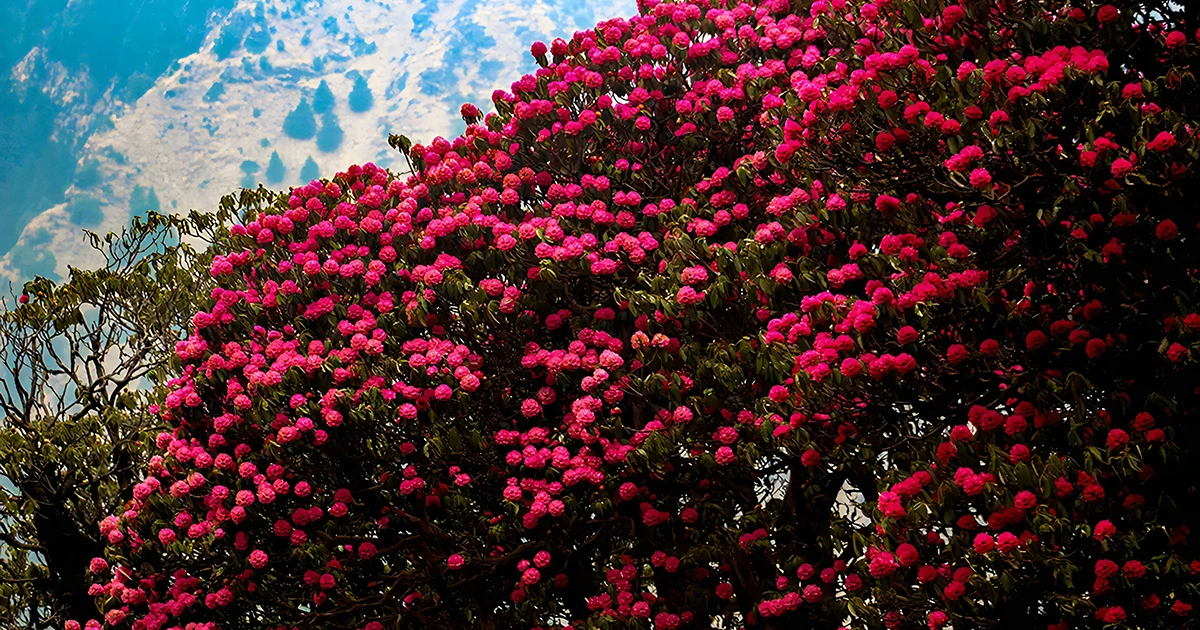
Rhododendron is an evergreen or deciduous plant mainly found in Asia. This crimson Rhododendron flower blooms during the spring season. The flower covers the lush hills of Nepal from 1,200 m to 5,500 m, starting from a low altitude of 1000 m above sea level. It has 33 species, and 31 species are found in Province 1 alone.
From March to May, this flower transforms the forest into a vibrant spectacle, with rhododendron blooms painting the landscape in red, pink, and white tones. Seeing these blossoms against the backdrop of snow-capped peaks such as Dhaulagiri, Annapurna, and Machhapuchhre creates a breathtaking panorama. A wide range of tones—pink, light pink, yellow, white, and purple- create a mesmerizing textile of color against the setting of gigantic peaks.
In Nepal, there is a large variety of species of Rhododendron, such as
- सुनखरी गुराँस (Rhododendron anthopogon)
- लाल गुराँस (Rhododendron arboreum)
- ठुलो लालीगुराँस (Rhododendron campanulatum)
- स्नो गुराँस (Rhododendron nivale)
- कालो गुराँस (Rhododendron barbatum)
- चिम्से गुराँस (Rhododendron cinnabarium)
- वाल्लिच गुराँस (Rhododendron wallichii)
- थोम्सन गुराँस (Rhododendron thomsonii)
The particular type has a designated altitude to survive. There are jungles of mixed types of rhododendrons in Ilam and Panchthar. Species found at various altitudes, such as Sunpati (R. anthopogon), Laliguras (R. arboreum), Neelo Chimal (R. campanulatum), and Hiun Guras (R. nivale), can be seen as scattered individual trees or dense shrubs around slopes and high alpine meadows.
However, other species like Rato Chimal (R. barbatum), Sano Chimal (R. cinnabarium), Wallich’s Chimal (R. wallichii), and Thomson’s Chimal (R. thomsonii) are observed growing either together or in association with other plant groups. Rhododendrons primarily grow alongside oak, birch, Bhote Champ (Michelia), bamboo, and various species of pine and juniper. The shortest tree of Rhododendron lowndesii can grow only up to 10 cm.
Another type of Rhododendron from the family Ericaceae, which contains a compound called “grayanotoxin,” is consumed by bees and synthesizes the mad honey. This is a psychoactive compound that creates hallucinations when consumed in high amounts. This compound also makes the muscle numb, gives a trippy sensation, and promotes relaxation.
Trekking Experience Through the Rhododendron Forest
The Ghorepani-Poon Hill trek is a popular route offering a perfect blend of natural beauty, cultural experiences, and moderate trekking challenges. Typically, the trek commences after a 1.5-hour drive from Pokhara to Birethanti.
Trekking through Tikhedhunga and Ulleri, we reach Ghorepani at 2,860 m in the shadow of the Rhododendron Forest. Early in the morning, we hike to Poon Hill to feel the warmth of the sunrise.
Along with the rhododendrons, the forest is home to diverse plant species, rare orchids, and medicinal herbs. Exotic species such as langurs, Himalayan monals (Danphe, Nepal’s national bird), and musk deer are found in the forest.
Some other famous rhododendron treks in Nepal are listed below:
- Langtang Valley Rhododendron Trek
- Annapurna Sanctuary Rhododendron Trek
- Tinjure Milkhe-Jaljale Rhododendron trek
- Ghorepani Poon Hill Rhododendron trek
- Pikey Peak Trek
- Mohre Danda Trek
- Mulde Hill Trek
- Khopra Danda Trek
- Milke Danda Trek
If you are looking for a rhododendron view trek, choose the most suitable one.
The Role of ACAP in Rhododendron Conservation
The Annapurna Conservation Area is the largest protected area under the ACAP and a UNESCO-designated biodiversity hotspot. The Annapurna Conservation Area Project (ACAP) is responsible for preserving the ecology and cultural heritage of the Annapurna region. Sustainable and responsible tourism practices and community involvement in waste management are crucial.
Seasonal Splendor: When to Visit for Full Bloom
The ideal time to explore the rhododendron in Nepal is during the Nepali months of Chaitra and Baisakh (March–April), when the blooms are at their crowning. However, the Ghorepani-Poonhill trek is a year-round adventure, offering different charms each season, from lush green landscapes in summer to snow-tipped trails in midwinter.
The world’s largest rhododendron forest in Ghorepani-Poonhill is not just a destination. It’s an experience that combines natural beauty, cultural richness, and adventure.
Whether you’re a seasoned trekker, a nature lover, or someone seeking serenity amidst the Himalayas, this remarkable region promises memories that will last a lifetime. So if you plan to visit Nepal this summer, don’t miss out on a trek to one of these forests.
Enjoy the variety of rhododendrons in Nepal!
FAQs
Expand AllWhere is Rhododendron found in Nepal?
Rhododendron is found in the hilly regions of Nepal. The Annapurna Conservation Area, Kanchenjunga Conservation Area, and Langtang Valley regions are some of the best spots to see Rhododendron forests.
Is Rhododendron Nepal's national flower?
Yes, the Rhododendron flower is the national flower of Nepal.
What do you call Rhododendron flower in Nepali language?
The national flower of Nepal, Rhododendron, is called Laliguras, i.e.लालीगुराँस in Nepali.
What is the symbol of Rhododendron in Nepal?
Since Rhododendron is crimson red in color, it symbolizes victory in war.
In which month do rhododendron bloom in Nepal?
Rhododendrons bloom during spring seasons in Nepal. It falls during March till May, which is also the trekking season in the country.
How many types of Rhododendron can be found in Nepal?
There are more than 30 types of Rhododendron found in Nepal.
Is Rhododendron only found in Nepal?
Even though Rhododendron is the national flower of Nepal, it isn’t only found in the country. You can find the flower in the Himalayas of Asia, including India, China, and South Korea.
What is the correct pronunciation of Rhododendron arboreum?
The correct pronunciation of “rhododendron” is /roʊdəˈdɛndrən/, and the word “arboretum” is pronounced /ˈɑːrbərɪəm/.
What is a rhododendron?
A rhododendron is a flowering shrub or small tree known for its bright, colorful blooms and large green leaves. It belongs to the genus Rhododendron, which includes over 1,000 species.
Can you eat rhododendron?
No, all the rhododendron flowers and leaves are not edible. Some of them are toxic and contain grayanotoxanes, which can cause nausea, dizziness, and even serious health issues.
Only some species, like Rhododendron arboreum, are edible and are good for health.
How many types of rhododendrons are found in Nepal?
Nepal is home to over 30 species of rhododendrons, making it one of the most rhododendron-rich regions in the Himalayas. The most famous is Rhododendron arboreum (Lali Gurans), the national flower.
How many rhododendrons are present in the national emblem of Nepal?
The national emblem of Nepal features 14 rhododendrons surrounding the country’s map and flag. These symbolize the national flower and the natural beauty of the land.
What are rhododendron plants?
Rhododendron plants are small shrubs characterized by bright, trumpet-shaped petals and thick, leathery leaves. There are hundreds of species of rhododendron, all belonging to the genus Rhododendron. They are found in the hilly and lower Himalayas region of Nepal between 1,500 and 4,000 meters.
What does a rhododendron look like?
The shape, size, and color of the rhododendrons differ with altitude. They are found. Red, pink, white, and purple are the most common flowers of this species. Some of the trees are a foot high and can be as tall as 20 m.
What are the different species of rhododendron in Nepal?
More than 33 species of rhododendrons are found in Nepal. Some of the species are
- Rhododendron anthopogon
- Rhododendron arboreum (Lali Gurans)
- Rhododendron barbatum
- Rhododendron campanulatum
- Rhododendron cinnabarinum
- Rhododendron lepidotum
- Rhododendron nivale
- Rhododendron thomsonii
- Rhododendron wallichii
Where can you find rhododendron forests in Nepal?
Rhododendron forests are found in the high hills of Nepal, from the eastern to western parts of Nepal. Some of the places famous for rhododendrons include
- Ghorepani–Poon Hill in the Annapurna region
- Langtang National Park
- Makalu-Barun National Park
- Tinjure–Milke–Jaljale Ridge in eastern Nepal
- Rolwaling Valley and Dhorpatan in western Nepal
- Kanchenjunga region
Are there treks that pass through rhododendron forests in Nepal?
Yes, most of the trekking trails pass through the vibrant rhododendron forests. These treks offer a magical walking experience under colorful floral canopies. Some of the major trekking trails are
- Ghorepani–Poon Hill Trek in the Annapurna Circuit
- Mardi Himal Trek
- Langtang Valley Trek
- TMJ Trek
What does the red rhododendron of Nepal look like?
The red rhododendron, the species Rhododendron arboreum, has deep crimson blossoms with multiple petals and longer green leaves.
What are the most common types of rhododendrons in Nepal?
The most common species of rhododendrons in Nepal is the Rhododendron arboreum, which is the national flower of Nepal.
Is there a rhododendron tree in Nepal?
Yes. Some species of rhododendrons grow as shrubs, whereas some species, like
Rhododendron arboreum grows as a tree up to 20 meters tall. This is the most common species of rhododendrons found in the hills of Nepal. This variety is the most prominent tree in the forests of Annapurna, Langtang, and the eastern hills.
What is rhododendron honey from Nepal?
Rhododendron honey is a dark-colored honey produced by honeybees by feeding on rhododendron flowers. Such honey is very rare and found mainly in the high hills of central and eastern Nepal. The rhododendron honey has unique medicinal values as well as some intoxicating effects and might cause hallucinations if taken in high quantities.
Is rhododendron honey from Nepal safe to eat?
Some varieties of rhododendron, such as Rhododendron ponticum, may have grayanotoxins, which can cause dizziness or nausea if consumed in large quantities. They have slightly intoxicating effects due to natural compounds in the nectar. So, it is also known as mad honey. Local honey is usually filtered and harvested and used with caution.
What are the health benefits of rhododendron honey in Nepal?
The Rhododendron honey has been harvested from early ages using traditional methods and is believed to have the following advantages to health.
- Help to cure indigestion.
- Relieve coughs and sore throats.
- Reduce high blood pressure.
- Act as a mild sedative.
Related blog posts
Discover a choice of tourist destinations loved by most of our visitors. Whether you're on a jungle safari to spot rare animals or walking through a world heritage site, these well-planned itineraries cover the major highlights of Nepal.



 call an expert at: