
How Do Full Moon Nights at Mansarovar Become So Spiritually Important?
 Amrit K. Aryal
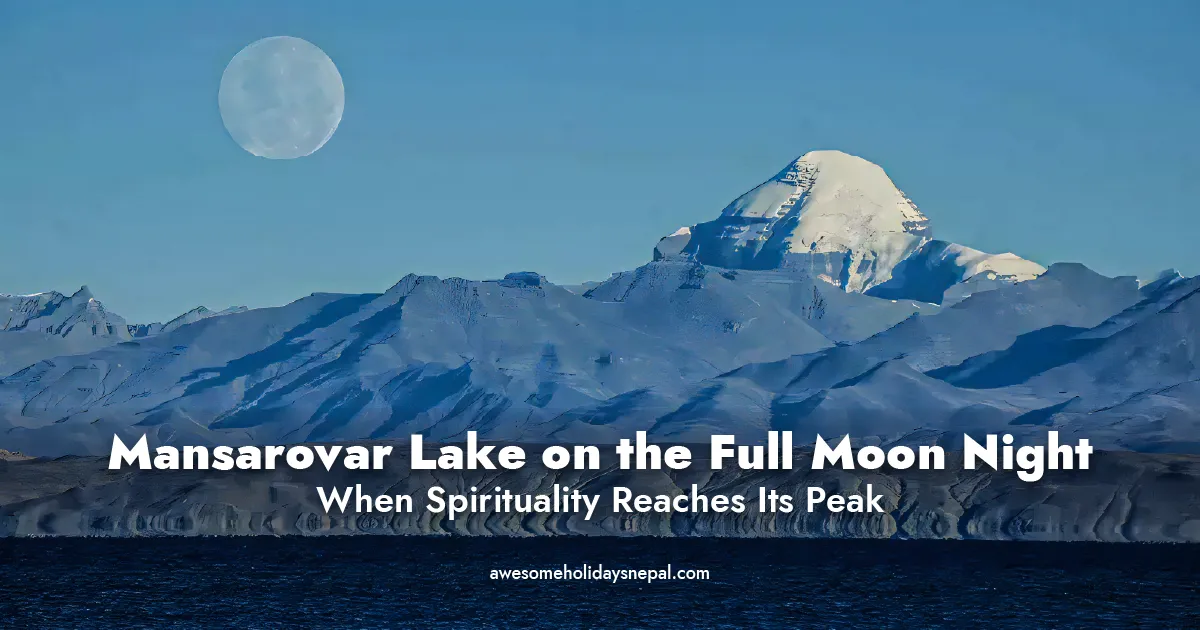
There are places on Earth where silence feels active. It’s doing something for you. Lake Mansarovar is one such place. On ordinary days, it already feels larger than logic. On full moon nights, something shifts. Pilgrims speak less. Even the restless ones slow down. The water holds the moon in a way that feels deliberate, not accidental.
The full moon in the Mount Kailash region has been observed, waited for, walked toward, and quietly feared for centuries. Not because of spectacle. But because of what people believe happens inside them during that time. This blog will try to investigate the spiritual beliefs of people who hold them attached to Mount Kailash and Lake Mansarovar. It will look inside not only myth and belief but also the scientific reasons behind them.

Some unanswered questions like “Why do Yatris select their Kailash Kora around full moon nights? Why are Mansarovar and Rakshastal sitting together but are very different? Why did Lord Shiva choose to stay in Kailash? And many more.
This is not a promise of miracles. It is an explanation of meaning. And meaning survives longer than hype.
Mansarovar and Rakshatal as a Paired Landscape
Twin lakes of Tibet, Mansarovar and Rakshastal, sit close to each other. But these two lakes share different energy. Mansarovar is a freshwater lake, and Rakshastal is salty. One is reflective, another is restless. Locals there do not treat them as opposites. For them, it is the yin-yang, representing two moods of the same mind.
Lake Mansarovar is where people bathe, chant, rest, and stay silent within. Rakshastal is where people walk faster and avoid touching the water. Both fall silent, but one feels peaceful, and the other feels dark.
There are myths that dark forces played over Lake Rakshastal. The Ramayan, a Hindu Epic, describes that the king of Lanka, Ravan, meditated on the island of Rakshastal. Lake Rakshastal is often misunderstood. It does not mean evil as described in the movies. It means untamed, raw, and unsettled.
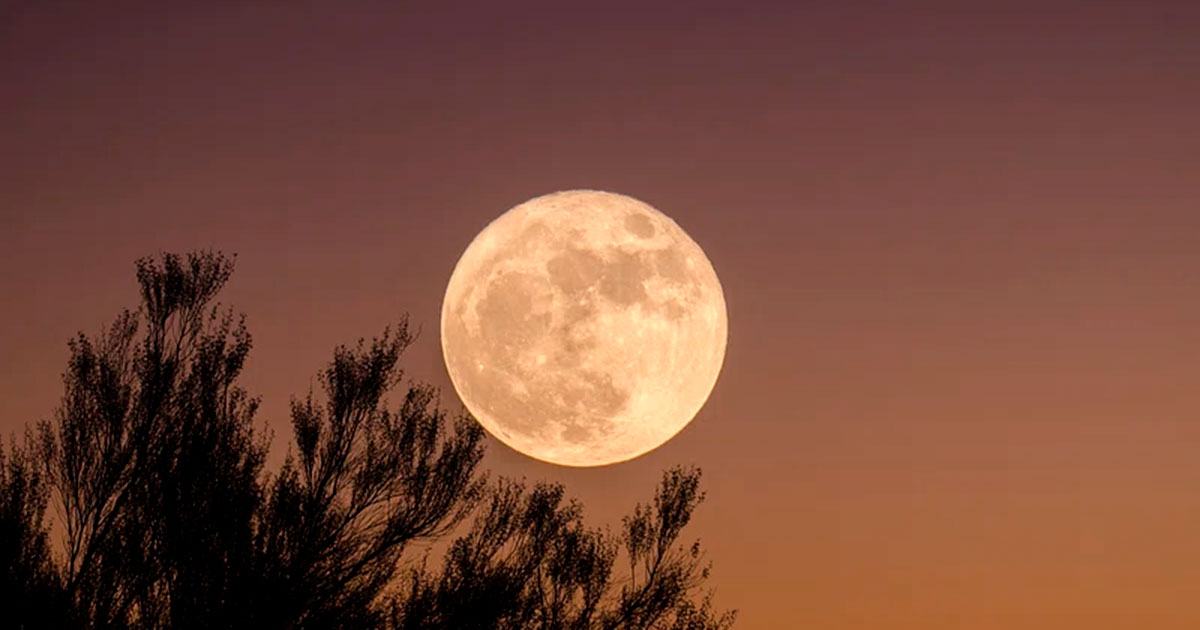
Pilgrims feel the difference in energy during the full moon. The vibe becomes sharper. Mansarovar is almost still. Even the wind seems hesitant. Rakshastal reflects moonlight unevenly and brokenly, maybe due to the irregular shape of the lake.
There are stories when pilgrims shared that they could not sleep well around the Rakshastal on the full moon. The silence became loud, the breathing became heavier, and the thoughts went into a loop.
One must be able to bring a balance in energy when you are in the Rakshastal, especially during the full moon nights. Making a tour around Lake Mansarovar is not only about accumulating purity but also about bringing a balance between the negative and positive energy. Balance is to bring peace. Pairing is important. Spiritual traditions around Mount Kailash do not focus on purity alone but on a balance in nature.
Lord Shiva in Kailash and the Full Moon Connection
For believers of Shiva and Shakta, Mount Kailash is the abode of Lord Shiva. The full moon nights are not just calendar events; it is a period of high energy flow. Lord Shiva is associated with stillness, death, destruction, renewal cycles, and pause. Pilgrims feel lord shiva seating there, watching in stillness. He is sitting there, meditating in stillness. The mountain itself becomes that posture, unclimbed, undisturbed, and complete. The moon comes closer to the earth, amplifying this symbolism.
The moon is tangled there in the hair of Lord Shiva, controlling time and tides. When the light of the moon falls on the Mansarovar, it mirrors the inner state of Shiva himself. The clear light represents awareness and alertness of Shiva.
Four Faces of Kailash and Full Moon Light
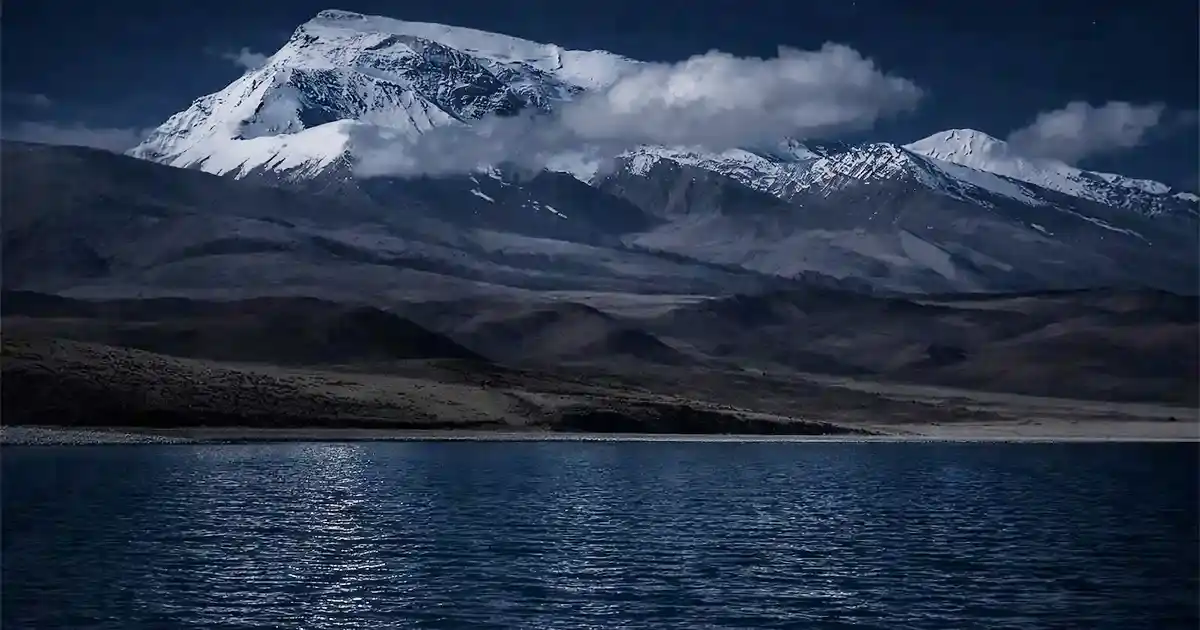
The four faces of Kailash are what we talk about endlessly. Some see Shiva’s face, some see Buddha’s face, and for them it is the Rishavdev. People imagine different shapes there. Many claim that they encounter OM on Kailash. It is about the imagination and the timing that creates the art in the mountains. In Mount Kailash and Mansarovar, the shadow behaves differently.
The sharp edges soften, and faint lines appear that are not visible in daylight. This is also verified by the various images taken by NASA. There is symmetry between faith and science. Many pilgrims say that they saw some strange light falling from the sky and vanishing in Lake Mansarovar. Cameras also could capture the strange light form during the night. Here, belief does not need verification and proof. Personal experience does not seek verification.
Pilgrim Rituals and Spiritual Practices During the Full Moon
Humans have been fascinated with full moon nights for centuries. Movies often depict the full moon night with Werewolves and dark energy. The full moon at Lake Mansarovar is not only admirable but also believed to be connected with the natural unseen force in nature. This is why pilgrims perform quiet rituals and puja in their traditional way. The Lake Mansarovar is considered one of the purest forms of water in the Himalayas. In addition, the lunar cycles have long been connected with spiritual practice in both Hindu and Buddhist traditions.
On the evening of the full moon, people often gather around Lake Mansarovar to perform silent but meaningful rituals. They offer water to the moon, pray, offer butter lamp lights, or incense facing the mountain. Some sit silently, meditate, chant mantras dedicated to Mount Kailash Shiva or Buddha.
Image of a Buddhist praying with a mala
Best Time to Experience the Full Moon at Mansarovar
Not every full moon is accessible in Mount Kailash and Mansarovar. The Yatra for Kailash Manarovar remains closed from November to May. This limited access to the journey makes it more auspicious for pilgrims. Most pilgrims from India and abroad plan their journey between June and September, when roads are smooth, and the weather is clear for the best experience.
And in 2026 is the year of the Horse, a cosmic year that repeats every 12 years, with a full moon in May, also known as Saga Dawa. Saga Dawa is considered the most spiritually significant full moon in the year, as per the lunar calendar. Saga Dawa is a festival that is associated with the birth, enlightenment, and Parinirvana of Siddhartha Gautama Buddha, a prince who gave up royalty in search of truth.
Thousands of pilgrims gather around the Tarboche and Yamadwar to celebrate the Saga Dawa. Completing the Mount Kailash Kora trek during Saga Dawa is considered highly auspicious among Buddhists and Bons in Tibet.
For photographers and travelers, the full moon in this season provides clear visibility, requiring less artificial light in the region to capture the reflection of Mount Kailash in the calm water of the lake. For many pilgrims, this quietest moment near the lake becomes one of the most memorable parts of the entire Mount Kailash Yatra.
Full Moons in 2026
| Month | Full Moon Date | Start Time | End Time | Remarks |
| Jan-2026 | 03 January | 03 Jan 26 | 14 Jan 25 | Paush Purnima |
| at 06:02 PM | at 03:56 AM | |||
| Feb-2026 | 02 February | 02 Feb 26 | 12 Feb 25 | Megha Purnima |
| at 06:09 AM | at 07:23 PM | |||
| Mar-2026 | 03 March | 03 Mar 26 | 14 Mar 25 | Phalguna Purnima |
| at 07:37 PM | at 12:24 PM | |||
| Apr-2026 | 02 April | 02 Apr 26 | 13 Apr 25 | Chaitra Purnima |
| at 10:11 AM | at 05:52 AM | |||
| May-2026 | 02 May | 11-May-26 | 12 May 25 | Vaishakh Purnima |
| at 01:23 AM | at 10:25 PM | Buddha Purnima | ||
| May-2026 | 31 May | 31 May 26 | 11 Jun 25 | Dev Snan Purnima |
| at 04:45 PM | at 01:13 PM | Jyeshtha Purnima | ||
| Jun-2026 | 30 June | 31 May 26 | 11 Jun 25 | Dev Snan Purnima |
| at 07:56 AM | at 01:13 PM | Jyeshtha Purnima | ||
| Jul-2026 | 29 July | 29 Jul 25 | 11 Jul 25 | Guru Purnima |
| at 10:35 PM | at 02:06 AM | Ashadha Purnima | ||
| Aug-2026 | 28 August | 28 Aug 25 | 09 Aug 25 | Narali Purnima |
| at 12:18 PM | at 01:25 PM | Jandhyala Purnima | ||
| Sep-2026 | 27 September | 27 Sep 25 | 07 Sep 25 | Bhadrapada Purnima |
| at 00:49 AM | at 11:38 PM | |||
| Oct-2026 | 26 October | 26 Oct 25 | 07 Oct 25 | Sharad Purnima |
| at 12:11 PM | at 09:17 AM | Ashwina Purnima | ||
| Nov-2026 | 24 November | 24 Nov 25 | 05 Nov 25 | Kartika Purnima |
| at 10:53 PM | at 06:49 PM | |||
| Dec-2026 | 24 December | 24 Dec 25 | 05 Dec 25 | Margashirsha Purnima |
| at 09:08 AM | at 04:44 AM |
Full Moon and the Kailash Kora Experience
Kailash Kora is difficult. Walking 52 km of rough terrain in three days is not an easy task. The kora feels harder during the full moon period. The days are windy, and the nights are colder. The sleep is disturbed, yet people are determined to complete the Kora. Only experienced pilgrims are authorized for the inner kora. The full moon is believed to decrease the distance between intention and awareness, taking the pilgrim to the world of spirituality.
Locals prefer going to the inner kora during the full moon. As the trek to the inner kora is not permitted for foreigners, they can only wish for it. The inner kora is more demanding and challenging. Circumambulating around Kailash under a full moon changes the rhythm. Steps become slower, they chatter less, and loud chanting is softened.

Historical Mentions and Living Practice
Ancient texts from Hindu, Buddhist, Jain, and Bon traditions all reference lunar timing, indicating the full moon with higher energy. They do not explicitly highlight the pilgrimage only during the full moon but emphasize checking the moon cycles for night rituals and water offerings.
Tibetan local people do not prefer the lake to be disturbed. They avoid disturbing Lake Mansarovar on certain full moon nights. They perform their ritual in silence and avoid unnecessary movement around the lake. Check out this link for the full moon in 2026.
Full Moon Nights and Practical Understanding
Full moon nights are not always easy. The temperature drops sharply at night, disturbing your sleep. Even the reflection from the lakes is disoriented. Though there is no proof, the full moon is said to bring emotional imbalance in women. Here comes the need for an experienced guide.
The Kailash group on a full moon night must be handled by someone having more insight into religion and insight. Not just logistics handlers, but someone who can understand the emotion under silence. Awesome Holidays Nepal has built a reputation not just on routes but on restraint. Personalized trekking and adventure packages are designed with cultural rhythm in mind.
Final words:
Full moon nights at Mount Kailash and Lake Mansarovar become spiritually important for people following every religion. The tales pass from generation to generation. Ancestors have seen the pattern. They have seen the lakes reflecting something more than only the light.
If you choose to go on the Mount Kailash Mansarovar Yatra, go prepared. Go with respect and patience. Because some journeys create a history and solve mysteries of a lifetime. Feel the silence and feel Mansarovar in the full moon in 2026.
FAQs
Expand AllWhat is Rakshas Tal?
Rakshas Tal is also called the twin lake of Mansarovar. It is a saltwater lake with no biosphere. People believe this lake is cursed.
Has Mount Kailash ever been climbed?
No. Mount Kailash has never been climbed. Some attempts have been made in the past, but they were not successful.
How to reach Mount Kailash from India?
There are two main ways to reach Kailash from India.
One is the Lipulekh Pass route via Uttarakhand.
Another one is from Kathmandu, Nepal.
Why is Mount Kailash famous?
Mount Kailash is a mountain with religious significance. Pilgrims of four religions complete the Kora with spiritual belief. Hindus, Buddhists, Bons, and Jains show equal respect to Mount Kailash and Lake Mansarovar.
Why is Mount Kailash mysterious?
Mount Kailash is perfectly symmetrical in geometry, yet it has four distinct faces. People often see the faces of some divine persons. Magnetics and electronics behave differently there.
Why does Mount Kailash turn gold?
During the sunset and sunrise, the golden light falls on the mountain, reflecting the golden tone. Feeling explains the rest.
Who discovered Mount Kailash?
Lord Shiva discovered Mount Kailash and made his abode. He resides there with his wife and children.
What is inside Mount Kailash?
No one ever knows. Still, some people believe that the gate opens to a mystical kingdom of Shangri-La. Kailash is considered the center of Universe often called the Axis Mundi.
What is on top of Mount Kailash?
The top of Mount Kailash is made up of hard rocks covered by Snow. there are no flags, no footsteps of any humans. It is the most holy mountain.
Why is the full moon at Lake Mansarovar considered spiritually important?
Mount Kaialsh is religious and spiritual in many religions. In Hindu and Buddhist traditions, the full moon represents clarity, completion, and spiritual awareness.
This symbol becomes stronger at Lake Mansarovar and Mount Kailash, as this mountain is the abode of Lord Shiva. The mountain and the entire region are sacred in Tibetan Buddhism, Bonpo, as well as in Jainism.
What happens at Lake Mansarovar during a full moon night?
On full moon nights, the lake becomes unusually quiet. Pilgrims gather around the lake, meditate, and offer water to the moon. Some people often walk around the lake chanting a mantra, and some just sit quietly.
Why do pilgrims prefer to visit Lake Mansarovar during the full moon?
Pilgrims travelling to Tibet for the Kaialsh Mansarovar Yatra believe that the full moon brings more energy as well as enhances spiritual practices. They often practise meditation, prayer, and a bath to rinse their body and mind. The full moon is considered an auspicious time to perform spiritual practices.
Is the full moon connected to religious beliefs about Mount Kailash?
Yes. In different beliefs such as Hinduism, Buddhism, Bon, and Jainism, the full moon is considered a sacred time in the month. In Hinduism, the moon is Lord Chandra, who is held by Lord Shiva on his head, in the form of a crescent moon. As Mount Kailash is the abode of Lord Shiva, pilgrims often choose to go to the Kailash Yatra during the full moon
How does the full moon reflect on Lake Mansarovar at night?
Lake Mansarovar during the full moon becomes clear and visible, and even the reflection of the mountain is seen more vibrant. Also, the high altitude and minimal air pollution in the region make the moonlight appear stronger than in many other places in Tibet.
Can pilgrims see Mount Kailash during a full moon at Mansarovar?
The visibility depends on the weather conditions around the lake. Some parts of the mountain are reflected on the calm lake if the weather is clear and there is enough light.
Is meditation during a full moon at Mansarovar considered special?
People believe that doing meditation during a full moon helps to remain focused. Doing rituals and meditation in Mount Kailash and Mansarovar on the full moon combines the energy, and the effect becomes deeper. The quietness around the lake also makes it easier for pilgrims to sit peacefully without distractions and meditate more deeply.
What spiritual traditions connect the moon with Lake Mansarovar?
The Lunar cycles are often connected with various traditions and spirituality. Hindus associate the moon with Lord Shiva, and Tibetan Buddhists consider the lunar calendar for meditation and religious activities. In the ancient Bon tradition, the Kailash Kora is influenced by the lunar cycles.
Do Hindu pilgrims perform rituals during the full moon at Mansarovar?
Yes. Hindu pilgrims offer hawan, puja after taking a bath in the serene water of Lake Mansarovar. Many pilgrims chant manta, light incense and diyo, butter lamps near the lake, and remember their deceased family members.
Some pilgrims offer prayers, chant mantras, or light incense and butter lamps near the lake. Others perform simple water rituals, offering small prayers while facing Mount Kailash. They also offer water to the lake Mansarovar as the abode of lord shiva.
Is bathing in Lake Mansarovar during the full moon considered sacred?
Bathing is an integral part of daily rituals in Hindu rituals. They often start their daily activities after a quick bath. During the full moon, pilgrims take a bath and perform rituals, puja on the shore of Lake Mansarovar. But during extreme cold, people just sprinkle the cold water and consider themselves cleansed.
What do Tibetan Buddhists believe about the full moon near Mount Kailash?
In Tibetan Buddhism, the full moon days are important for meditation, prayer, and creating merit. These days are also important for doing the Kailash Kora.
Is the full moon connected to the Saga Dawa festival near Mount Kailash?
Yes. Saga Dawa falls on one of the full moons and is celebrated with much higher importance. It commemorates the birth, enlightenment, and passing of Gautam Buddha.
Related blog posts
Discover a choice of tourist destinations loved by most of our visitors. Whether you're on a jungle safari to spot rare animals or walking through a world heritage site, these well-planned itineraries cover the major highlights of Nepal.
 call an expert at: