
Why do Nepalese Worship Kumari: The Living Goddess of Nepal
 Sujata Pokhrel
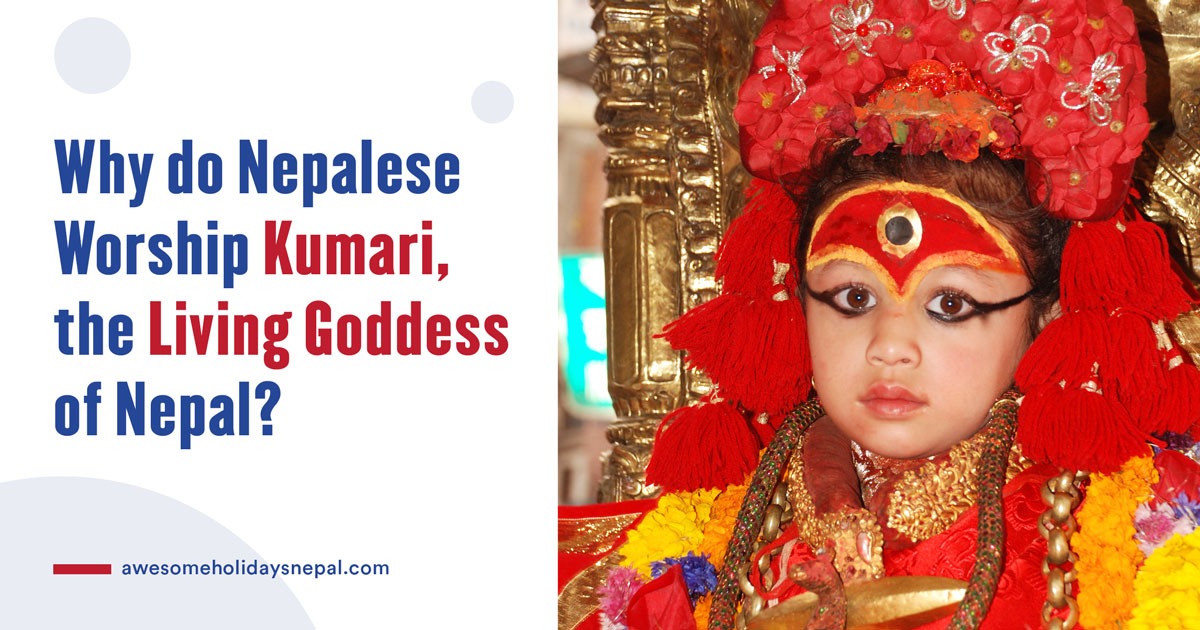
Nepal’s cultural practices are as unique and rare as its natural wonders. One such odd traditional practice is worshipping a young lady as Kumari, the living Goddess. A young girl dressed up in cultural attire with makeup and a representative sketch of a third eye on the forehead is how you can see the Kumari goddess.
Whenever you stroll around the world heritage site, the Kathmandu Durbar Square, on a city tour, you will come across a temple on your left as soon as you enter the courtyard. This temple is where you will find people worshipping Kumari.
Like most visitors, you may be curious to discover why Nepalese Worship Kumari, the living goddess of Nepal. Go through the article to find out why and how the tradition of the living goddess came into the picture in the history of Nepal.
Kumari: The Living Goddess of Nepal
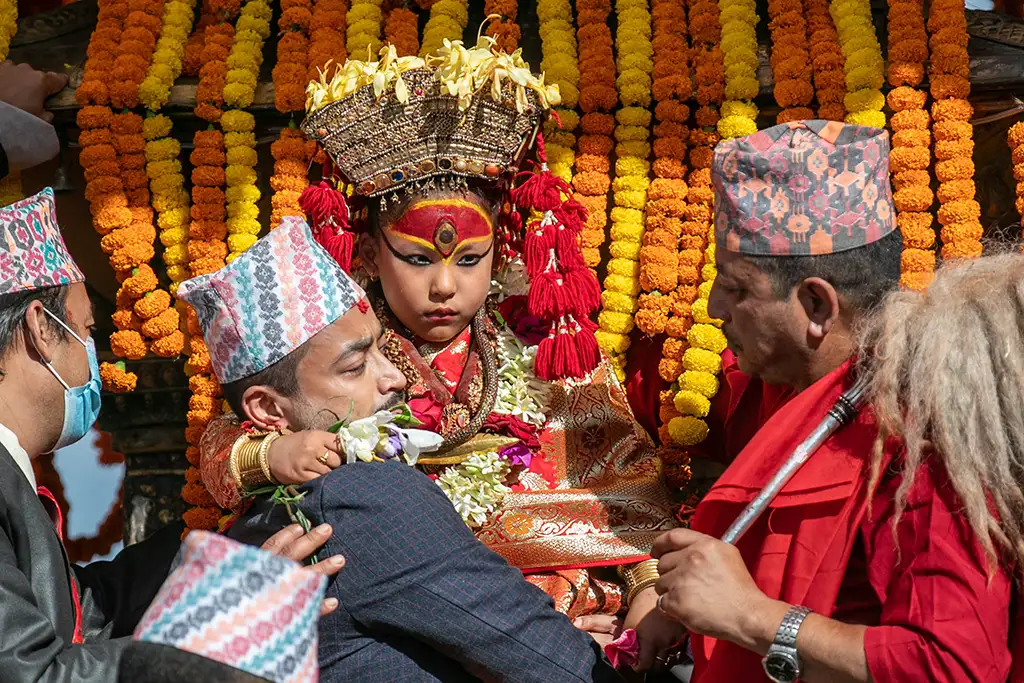
Kumari, the living goddess, is a cultural practice observed by the residents of Kathmandu Valley. She is a divine representation of the goddess Taleju Bhawani, who is dearly praised among Nepali people, specifically the royal families. Kumari, which also means “a virgin girl” in Sanskrit, is a young girl chosen through an intricate process.
The practice of worshipping Kumari is more prevalent among the Newari community, the ethnic residents of the valley. She is revered as a living incarnation of the goddess Taleju Bhawani and goddess Durga, a powerful one in Hindu mythology.
Taleju Bhawani is the most prestigious idol among the royal families of the Royal dynasties of Nepal. However, the practice of worshipping young girls as her living incarnation began during the reign of King Jayaprakash Malla.
The Legends Behind Kumari Tradition
While digging deeper into the history, you will encounter multiple myths and stories that explain how this tradition came into practice. One of the most famous legends says that the goddess Taleju used to play card/dice games with the king, but they had a conflict one fine evening. As a result, the goddess disappeared, getting offended by the king.
In a quest to bring her back, King Jayaprakash Malla pleaded with the goddess and asked for forgiveness. Yet, the goddess never returned. Instead, she appeared in his dreams and committed to appearing as an incarnation of a young girl. Since then, the Kumari tradition has come into practice.
How is a Kumari Chosen?
Choosing a Kumari isn’t as simple as it sounds. Only the daughters of the Shakya clan, a specific Buddhist family, qualify to be selected for the contest for the Kumari goddess. Young girls aged between 3 and 4 from those families are chosen and examined before selecting one. To be considered for the test in the first place, the young lady must possess some peculiar characters, often referred to as 32 characters or “32 lakshyana”.
32 Requirements to be a Kumari
The 32 requirements for a potential Kumari candidate incorporate a set of physical, social, and intellectual characteristics. First, her family lineage must be pure, as only a daughter born out of a true Shakya household qualifies. Any child born out of an inter-caste marriage isn’t divine per the mythology and hence doesn’t qualify.
Similarly, she needs to behave with peculiar physical characteristics like a goddess. Some of these include having a body like a banyan tree, chest like a lion, thick eyelashes like a cow, thighs like a deer, soft voice, and so on.
Apart from physical features, a Kumari needs to be sharp-minded and disciplined. To test her wit, the temple committee takes a particular test.
Test for Choosing Kumari
The five senior Buddhist Bajracharyas, the higher-ranked priests, can decide which candidate will be chosen. After taking a confidential test, the most potent candidate is selected as a Kumari for her reign. This test occurs during the nine black nights, also referred to as Kalratri, during Nepal’s national holiday, the Dashain festival.
Young girls must spend a night with 108 heads of buffalo and goats sacrificed in the name of the goddess Taleju. Following this test, the potential candidate must also search for a belong of the past Kumari in a dark room filled with masked men who make scary noises. She has to be fearless and find the item only with the support of a candlelight. Only if she succeeds and passes the tests will the girl get the honor of a Kumari.
People worship her until she remains divine. i.e., until she gets her menstrual cycle. Once she gets into puberty, her divinity is considered to be lost, and hence, another one is chosen following the same procedures.
Life as a Kumari Goddess
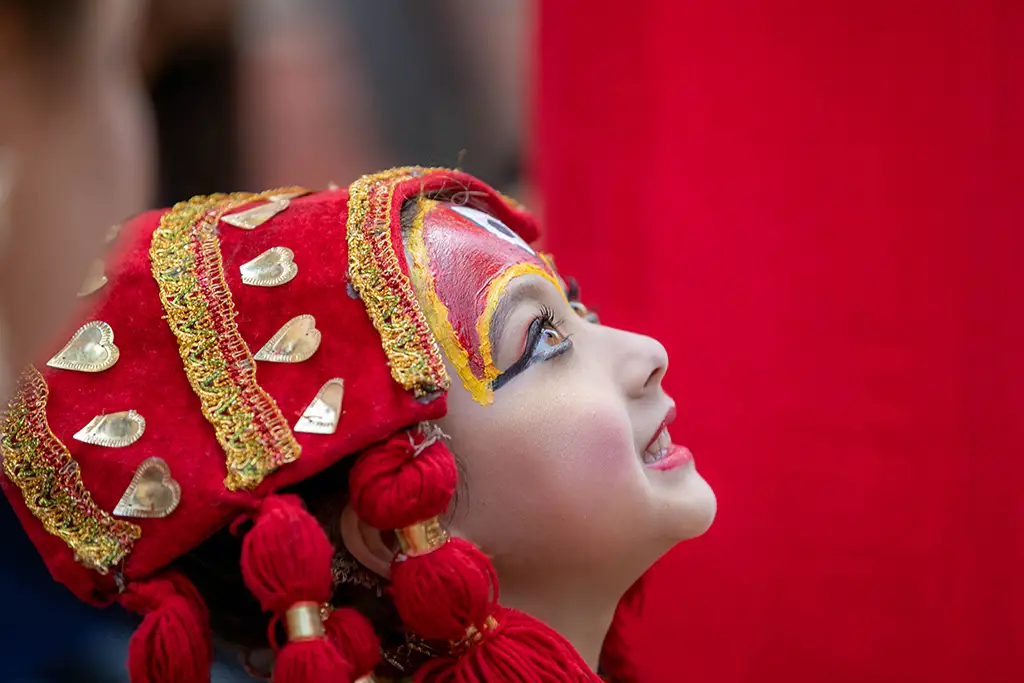
Despite being a prestigious role, living the life of a goddess isn’t easy. You must follow a set of rules and live in the Kumari palace, a designated house and a temple for the diving-loving goddess. Unlike other kids, Kumari isn’t allowed to play outside or interact with other kids.
She can only interact with her caretakers and live with them during her reign as a Kumari. People who want to worship her can visit the temple; however, not everyone can see her up close. If you want to catch sight of the Kumari goddess, you can visit the palace and wait until she looks upon you from a carved window.
Kumari goddess usually gives her divine sight early in the morning, around 9 am, and later in the evening, around 4 pm. If you visit the Kumari temple during these hours, you may get a chance to pray to her and look at the goddess.
Fascinating Facts About Living Goddess Kumari
Some facts about the goddess Kumari are as unique as the practice of worshipping young girls as a goddess. Here are some fascinating facts about the living goddess Kumari of Nepal that will blow your mind:
- A smiling Kumari is a curse to the person who sees it. Yes, you heard it right! A smiling young girl can be a curse on you.
- Kumaris aren’t allowed to touch the ground with their feet until their reign as a goddess. She is carried everywhere by her caretakers.
- The little girl has to live inside the Kumari house during her time as a Kumari. She lives here, eats there, and is home-schooled in the same house until her puberty.
- The goddess is most powerful during Jatras, a religious street carnival kind of festival. Kumari is taken out only during such jatras and carried around the city in a carriage.
- Kumari is considered the most powerful during Indra Jatra. She is considered at the peak of her power during the 9th day of the Dashain festival, also known as “Navami.” 6. Taleju temple also opens only on the day of Navami.
- A Kumari isn’t allowed to see the sacrifice of an animal. This is because the myths have it that the blood could contaminate the power within her. It is also a reason why the young girl is stripped of her entitlement as a Kumari as soon as she begins menarche.
- Not only the Kathmandu Durbar Square, but each palace square around Kathmandu Valley has its own Kumari. There are a total of 10 Kumaris in different temples and palaces in the whole of Nepal.
- The Kumari of Kathmandu Palace Square is considered the most powerful among all.
What does Life Look Like for Kumari after Dethronement?
Any girl who was once a Kumari gets to live an everyday life after dethronement. She can pursue her education, lead a normal, happy life, marry, and settle down as she matures. However, life after Dethronement wasn’t always like this.
In the past, once you were chosen a Kumari, you weren’t allowed to marry. There was a myth that whoever marries a Kumari lives a short life. However, the myth no longer exists.
Similarly, Kumari wasn’t allowed to pursue education as per the superstitious beliefs, so they could never continue to further education. But in the present context, a Kumari gets a formal education in her parents’ house and hence can continue once she leaves the Kumari house.
A Glimpse into Kumari’s Mysterious Daily Life
Beyond the divine reverence, Kumari leads a uniquely secluded life. Once chosen, she moves into the Kumari Ghar (her residence) adjacent to the Kasthamandap temple in Kathmandu. Her days are a blend of worship, rest, and strict ritualistic routines.
Kumari is forbidden from touching the ground with her feet; during outings, she’s carried in a golden palanquin or bier. Even simple actions like walking become ceremonial—her feet are considered so sacred that a cloth path is laid down wherever she steps. Only a few people, including her caretaker (Bajracharya) and a special assistant, can interact with her directly.
Despite these restrictions, glimpses of her playful childhood peek through the divinity: stories abound of Kumari enjoying hidden sweets or coloring her feet with vermilion during festivals. This mystique surrounding her daily life only deepens the devotion of the Nepalese people, who see Kumari not just as a goddess, but as a lively spirit connecting heaven and earth.
Kumari: Center of Faith and Tradition
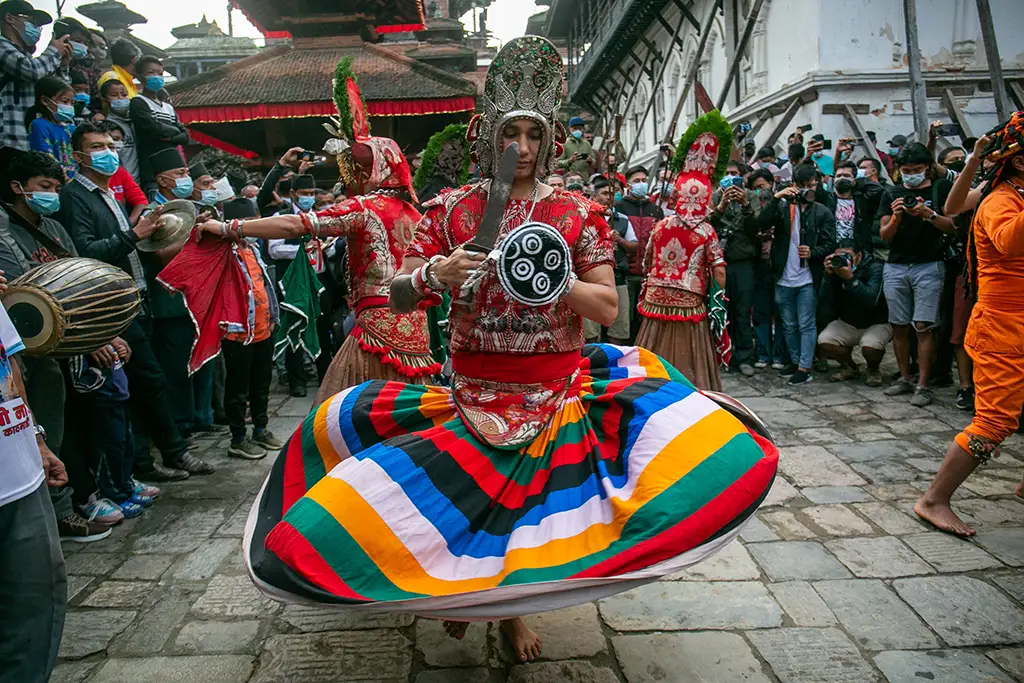
As a visitor, one can clearly see how the tradition of Kumari has preserved the integrity of the ethnic cultures and practices of Kathmandu Valley. The Kumari tradition isn’t just a cultural practice but a center of faith and history of the Royalties of Nepal.
In the present context, many humanitarians consider it a violation of child rights as young, innocent girls are bound to be locked inside a designated premise. However, the perspective must be amended to include a specific improvement in this cultural practice.
One needs to understand how this small tradition holds the cultural heritage of Nepali people and hence needs to be preserved. But of course, there should be moderation in the restrictions to meet the requirements of changing times.
FAQs
Expand AllWhat is a Kumari Goddess?
Kumari goddess is a living goddess in Nepal.
Who is the current Kumari Goddess?
The current Kumari of Kathmandu is Aryatara Shakya, who was installed in the role in September 2025. She hails from the Shakya clan of the Newar community in Kathmandu and will serve as the living goddess until she reaches puberty (per tradition).
What is a Kumari?
Kumari is a living goddess who is worshipped in Nepal.
What is Kumari Goddess known for in Nepal?
Kumari goddess is known as the divine and powerful goddess, Taleju Bhawani who is worshipped in both Hindu and Buddhist culture.
Who is the Kumari Goddess?
Kumari goddess is a young girl who is selected from a specific Newari clan and worshipped as a goddess until she gets her menstruation cycle.
Who is Goddess Kumari in Nepalese culture?
Goddess Kumari is reincarnation of a Hindu goddess Taleju Bhawani and hence is worshipped.
What happens if the Kumari Goddess smiles at you?
It is believed that smiling Kumari is a bad omen. If a Kumari smiles at you, it is considered a bad luck and can indicate a serious illness or a disastrous happening.
How is a Kumari Goddess chosen?
Kumari goddess is chosen through a highly selective and secretive process that includes astrological consideration and different difficult tests.
Why is the Kumari Goddess worshipped?
Kumari goddess is embodiment of Hindu goddess Taleju Bhawani and hence is worshipped. She is supposed to hold immense power and is worshipped for power and prosperity.
Where can you see the living Kumari Goddess in Kathmandu?
You can see the living goddess Kumari in her residence which is also called Kumari temple. The main Kumari can be seen in Kumari temple of Kathmandu Durbar Square, whereas there are other Kumari is durbar square of Patan and Bhaktapur.
What are the criteria to become the Kumari Goddess?
There are a set of 32 qualities that a girl needs to have for being chosen as a Kumari. She needs to have a perfect body, needs to be a virgin, must be in an excellent health condition, and needs to be specifically from Shakya clan of Newari community to be selected.
What rituals are followed for the Kumari Goddess?
A Kumari has to follow intense set of rules after she gets appointed for this role. She cannot go outside on her own, she can’t touch the ground, and she needs to make public appearances.
What happens to the Kumari Goddess after she retires?
After a Kumari goddess gets her menstrual cycle, she retires from the entitlement and then returns to her normal life.
Is the Kumari Goddess allowed to walk outside?
No, a Kumari is forbade to touch the ground until her term as a Kumari. She is carried on her caretaker’s lap whenever she has to walk outside during festivals.
How long does a Kumari serve as living goddess?
A young girl serves as a living goddess Kumari as long as she doesn’t gets her menarche i.e. until she gets her first period.
What makes the Kumari Goddess a unique tradition in the world?
The Kumari goddess beholds the cultural value of Nepalese as it represents the divine energy of Hindu goddess Taleju Bhawani. It is the only living goddess in the entire world which why it makes this a unique tradition.
What does the Kumari Goddess symbolize in Hindu and Buddhist beliefs?
The Kumari Goddess symbolizes the Hindu goddess Taleju Bhawani in Hindu beliefs and the female Buddha, Vajradevi in Buddhist beliefs.
Can foreigners visit the Kumari Goddess?
Yes, foreigners can also visit the Kumari goddess in Kathmandu. However, there are certain rules and restrictions that you need to follow.
Is the Kumari Goddess considered a reincarnation of a deity?
Yes, the goddess Kumari is considered reincarnation of the Hindu goddess Taleju Bhawani.
Why is the Kumari tradition controversial?
Kumari tradition is controversial because some social workers believe that it restricts young girls from enjoying their childhood and deprives them of living a free life like rest of the kids. They believe it has psychological impact on the young girls.
Related blog posts
Discover a choice of tourist destinations loved by most of our visitors. Whether you're on a jungle safari to spot rare animals or walking through a world heritage site, these well-planned itineraries cover the major highlights of Nepal.



 call an expert at: